01
Circle — Constant Radius & Zero Eccentricity
Given conditions: Discriminant Δ < 0, A = C ≠ 0, B = 0 (or e = 0)
Equation: x2 + y2 = r2
Worked example: x² + y² = 9 ⟹ Circle centered at (0,0) with radius r = 3
Open this conic: circle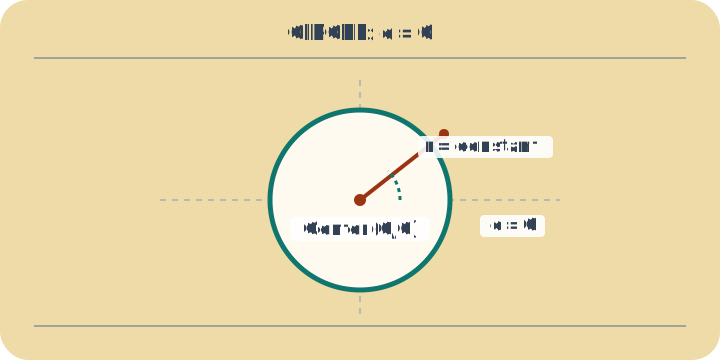
Interactive Math & Science Lessons
Conic Sections Theory — Curves of the Cone & Plane
Every conic section is formed by intersecting a double-nappe cone with a plane. The plane's tilt defines the geometric family, while its algebraic equation is classified by the discriminant Δ = B² - 4AC and eccentricity e.
01
Given conditions: Discriminant Δ < 0, A = C ≠ 0, B = 0 (or e = 0)
Equation: x2 + y2 = r2
Worked example: x² + y² = 9 ⟹ Circle centered at (0,0) with radius r = 3
Open this conic: circle
02
Given conditions: Discriminant Δ < 0, A ≠ C or B ≠ 0 (0 < e < 1)
Equation: x2/a2 + y2/b2 = 1
Worked example: 4x² + 9y² = 36 ⟹ Semi-major axis a = 3, semi-minor axis b = 2
Open this conic: tilted ellipse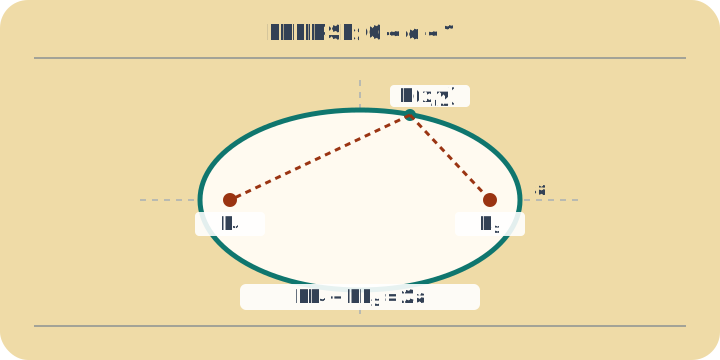
03
Given conditions: Discriminant Δ = B² - 4AC = 0 (e = 1)
Equation: y = a(x − h)2 + k
Worked example: y - x² = 0 ⟹ Vertex at (0,0), focus at (0, 0.25)
Open this conic: parabola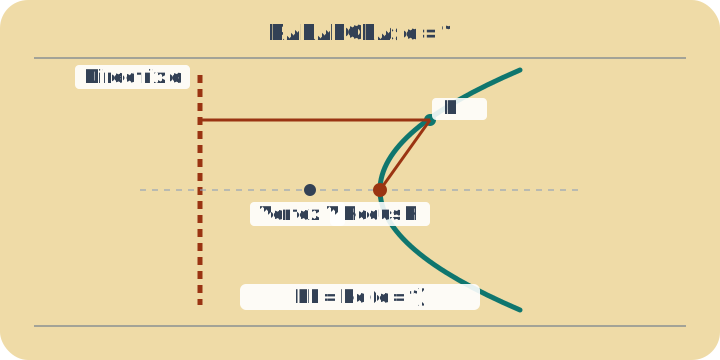
04
Given conditions: Discriminant Δ = B² - 4AC > 0 (e > 1)
Equation: x2/a2 − y2/b2 = 1
Worked example: x² - y² = 4 ⟹ Two branches opening horizontally with asymptotes y = ±x
Open this conic: hyperbola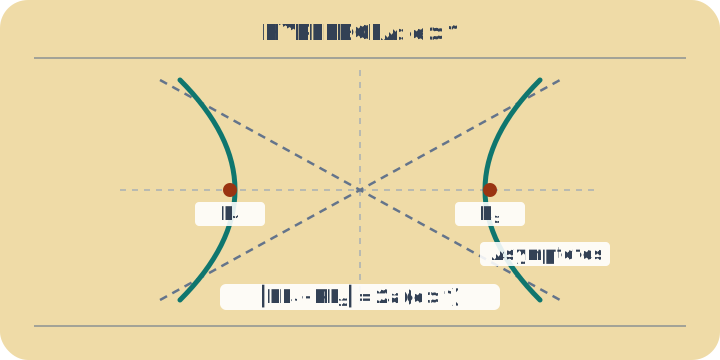
05
Given conditions: Plane passes directly through the central cone vertex
Equation: Ax2 + Cy2 = 0
Worked example: x² + y² = 0 (Point) or x² - y² = 0 (Two lines y = ±x)
Open this conic: degenerate lines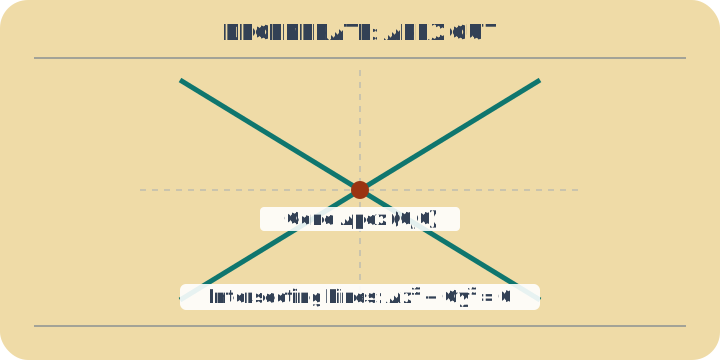
06
Given conditions: Mixed term B ≠ 0 in Ax² + Bxy + Cy² + Dx + Ey + F = 0
Equation: tan(2θ) = B / (A − C)
Worked example: 4x² + xy + 2y² = 16 ⟹ Rotated ellipse with tilted axes
Open this conic: near parabola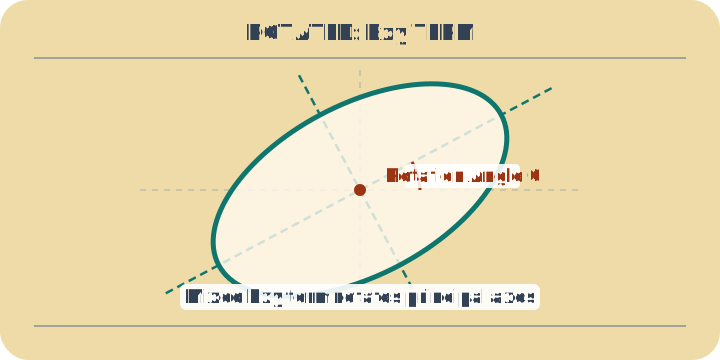
4x² + xy + 2y² = 16 is an ellipse, and the xy term means it sits crooked. Find the angle it is tilted by, its two axes and its eccentricity — none of which this panel prints.
The discriminant settles the family first. It is negative, so the curve is an ellipse, and no amount of rotating or shifting can change that.
Write the quadratic part as a symmetric matrix, with the xy coefficient split between the two off-diagonal entries. Its determinant is 7.75, and the discriminant is exactly −4 times it — the same test in different notation.
Rotating the axes by θ changes B, and the rotation that removes it entirely satisfies tan 2θ = B/(A − C). Solving gives a tilt of about 13.3°.
In the rotated frame the equation has no cross term, and the two new coefficients are the eigenvalues of that matrix. The ellipse is then in its familiar form.
The semi-axes follow, and with them the eccentricity: 0.737. That is a decidedly elongated ellipse — the short axis is 68% of the long one, and no planet in the solar system is on an orbit anywhere near that shape.
Answer
The tool prints Δ = −31 and classifies it as an Ellipse. Step 2 is why that classification can be trusted. Rotating the axes changes A, B and C individually, but it cannot change the determinant of the matrix they form, and the discriminant is nothing but that determinant times −4. So the ellipse–parabola–hyperbola boundary is a property of the curve rather than of the coordinates you happened to draw it in — which is exactly what a classification has to be to be worth having.