Series Convergence Explorer
Watch partial sums grow. Does the series converge to a finite limit or diverge?
Infinite Summation Limits 🖖
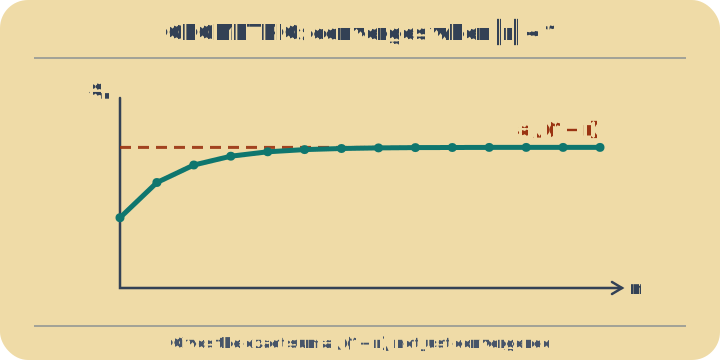
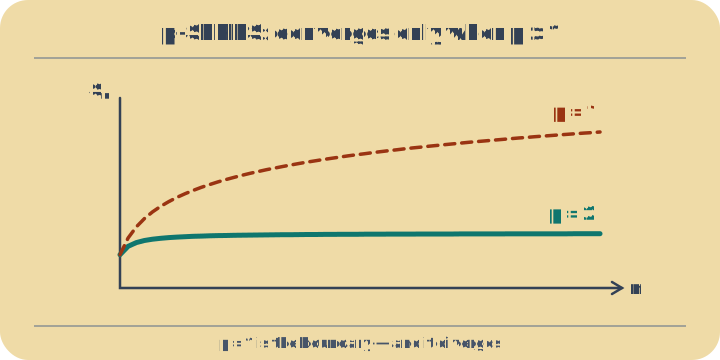
Series convergence rigorously examines if infinitely accumulated terms approach a finite boundary. The harmonic series famously diverges despite vanishing terms, whereas the geometric series guarantees limits under stringent ratio constraints, illuminating the subtle boundary between unbounded infinity and exact finite sums.
What a partial sum really is 🖖
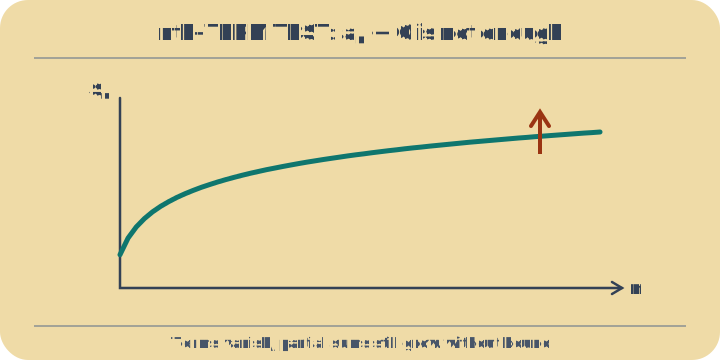
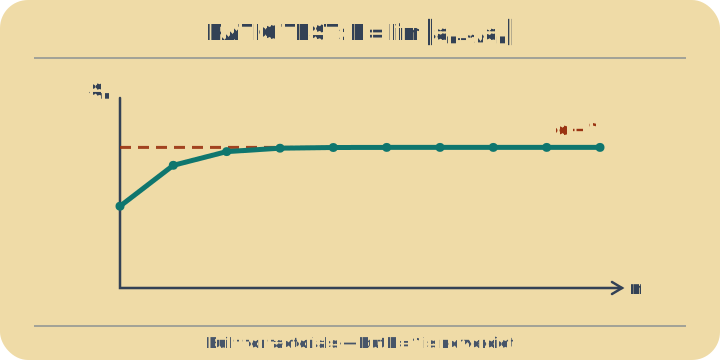
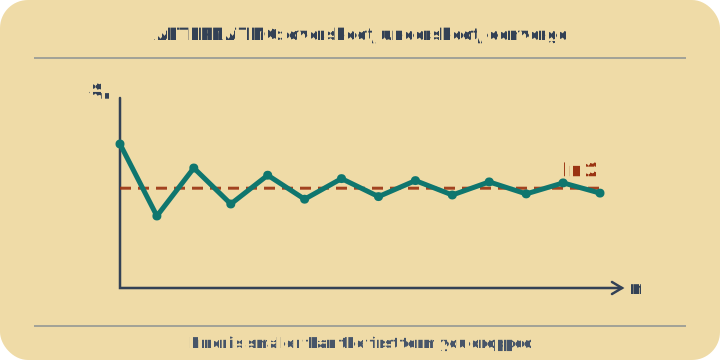
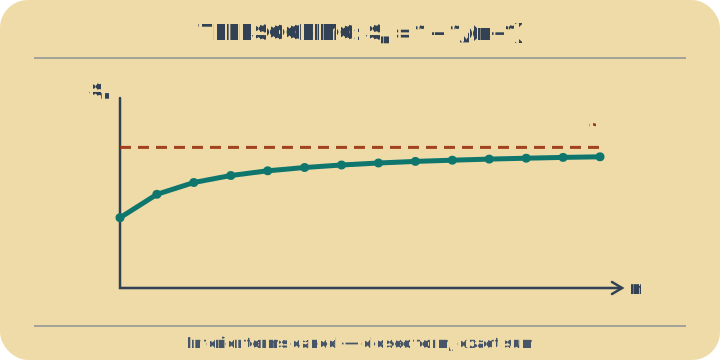
An infinite series is never summed all at once. Instead you track the partial sum SN, the running total of the first N terms, and watch where it heads as N grows. On the chart, if that curve flattens toward a horizontal line, the series converges to that height; if it keeps climbing, it diverges. Convergence is really just a sequence of totals settling down.
How the harmonic series stacks blocks 🖖
Stack identical blocks at the edge of a table. The top one can overhang the edge by at most ½ HN, half the N-th harmonic partial sum. Because the harmonic series diverges, this overhang has no limit — with enough blocks the top one hangs entirely past the table edge and beyond. Just 4 blocks already clear a full block-length, since H4 ≈ 2.08.
Example problems
- Harmonic - Harmonic
- Basel (π²/6) - Basel (π²/6)
- e−1 series - e−1 series
- Alt. Harmonic - Alt. Harmonic
- Geometric - Geometric
- Telescoping - Telescoping
- p-series - p-series