Series Convergence Explorer

Watch partial sums grow. Does the series converge to a finite limit or diverge?

Loading interactive simulation...

Infinite Summation Limits 🖖

Series convergence rigorously examines if infinitely accumulated terms approach a finite boundary. The harmonic series famously diverges despite vanishing terms, whereas the geometric series guarantees limits under stringent ratio constraints, illuminating the subtle boundary between unbounded infinity and exact finite sums.

What a partial sum really is 🖖

An infinite series is never summed all at once. Instead you track the partial sum SN, the running total of the first N terms, and watch where it heads as N grows. On the chart, if that curve flattens toward a horizontal line, the series converges to that height; if it keeps climbing, it diverges. Convergence is really just a sequence of totals settling down.

How the harmonic series stacks blocks 🖖

Stack identical blocks at the edge of a table. The top one can overhang the edge by at most ½ HN, half the N-th harmonic partial sum. Because the harmonic series diverges, this overhang has no limit — with enough blocks the top one hangs entirely past the table edge and beyond. Just 4 blocks already clear a full block-length, since H4 ≈ 2.08.

SERIES THEORY — WHICH CONVERGENCE TEST TO REACH FOR

Choosing a Convergence Test: Match the Test to the Shape

No single test settles every series. Each one is tuned to a particular shape of general term — a constant ratio, a plain power of n, a factorial, alternating signs — and applying the wrong one usually returns "inconclusive" rather than a wrong answer. Read the term first, recognise its shape, and the test picks itself.

nth-term test — the one that can only prove divergence lim an ≠ 0 ⇒ ∑an → ∞
Geometric — a constant ratio between terms Σarn, |r| < 1
p-series — a plain power of n underneath Σ1/np, p > 1
Ratio test — factorials and n-th powers L = lim |an+1/an|
Alternating — the sign flips every term Σ(−1)nbn, bn ↓ 0
Telescoping — the middle of the sum cancels Σ[f(n) − f(n+1)]

01

nth-term test — the one that can only prove divergence

Term looks like: Any series at all. Check this first; it costs a single limit.

Test: lim an ≠ 0 ⇒ ∑an → ∞

Worked example: Σ1/n has aₙ → 0, so the test says nothing — and the series diverges anyway.

Open this case: Harmonic
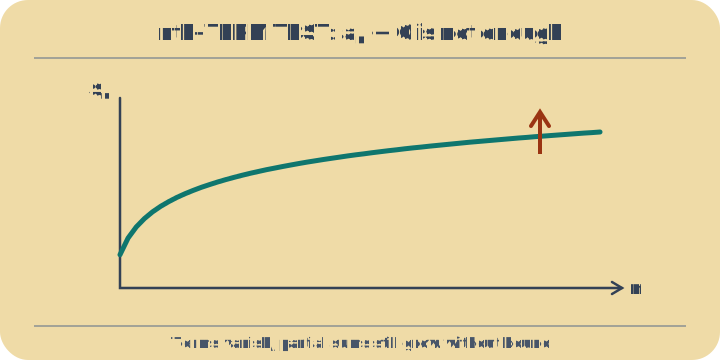
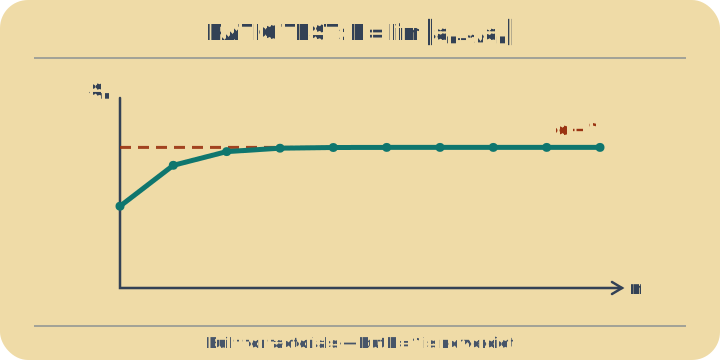
nth-term test — the one that can only prove divergence. Harmonic partial sums keep climbing even though the individual terms vanish. Any series at all. Check this first; it costs a single limit.
Harmonic partial sums keep climbing even though the individual terms vanish.

02

Geometric — a constant ratio between terms

Term looks like: Each term is a fixed multiple of the one before: aₙ₊₁/aₙ = r, the same r throughout.

Test: Σarn, |r| < 1

Worked example: Σ(1/2)ⁿ has r = 1/2, so it converges — and the total is exactly a/(1 − r).

Open this case: Geometric
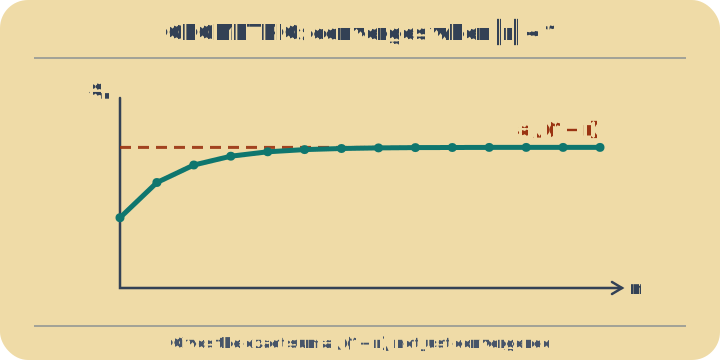
Geometric — a constant ratio between terms. A constant ratio below 1: the partial sums flatten onto the exact limit. Each term is a fixed multiple of the one before: aₙ₊₁/aₙ = r, the same r throughout.
A constant ratio below 1: the partial sums flatten onto the exact limit.

03

p-series — a plain power of n underneath

Term looks like: The term is 1/nᵖ and nothing more: no factorial, no alternating sign.

Test: Σ1/np, p > 1

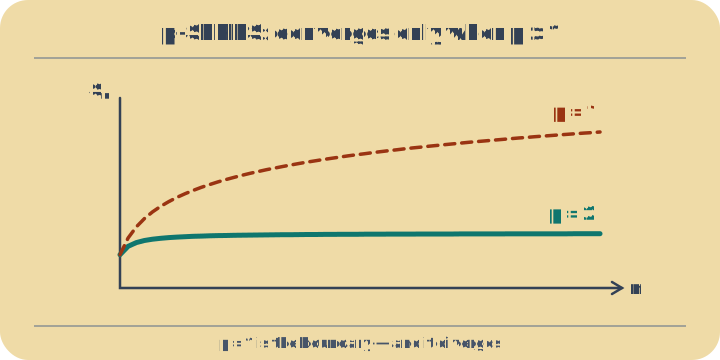
Worked example: 1/n² converges (p = 2); 1/n diverges (p = 1). The boundary is exactly p = 1.

Open this case: p-series
p-series — a plain power of n underneath. p = 2 settles quickly while p = 1 keeps climbing. The threshold is exactly p = 1. The term is 1/nᵖ and nothing more: no factorial, no alternating sign.
p = 2 settles quickly while p = 1 keeps climbing. The threshold is exactly p = 1.

04

Ratio test — factorials and n-th powers

Term looks like: The term contains n!, cⁿ or nⁿ. Compute L = lim |aₙ₊₁/aₙ|.

Test: L = lim |an+1/an|

Worked example: Σ1/n! gives L = lim 1/(n+1) = 0 < 1, so it converges — and very fast.

Open this case: e−1 series
Ratio test — factorials and n-th powers. 1/n! collapses onto its limit within a handful of terms. The term contains n!, cⁿ or nⁿ. Compute L = lim |aₙ₊₁/aₙ|.
1/n! collapses onto its limit within a handful of terms.

05

Alternating — the sign flips every term

Term looks like: The term carries (−1)ⁿ, and the magnitudes decrease steadily to zero.

Test: Σ(−1)nbn, bn ↓ 0

Worked example: Σ(−1)ⁿ⁺¹/n converges to ln 2, even though Σ1/n diverges.

Open this case: Alt. Harmonic
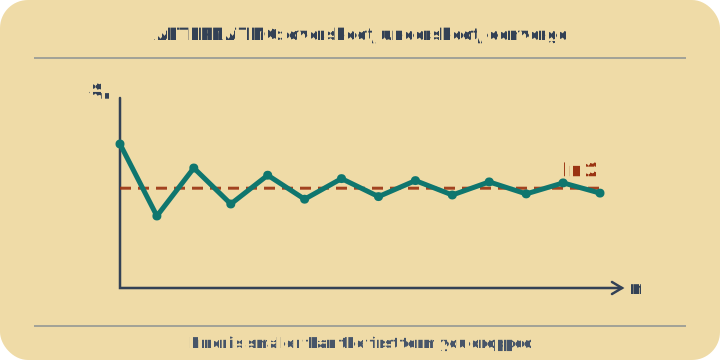
Alternating — the sign flips every term. Partial sums overshoot and undershoot in turn, closing in on the limit. The term carries (−1)ⁿ, and the magnitudes decrease steadily to zero.
Partial sums overshoot and undershoot in turn, closing in on the limit.

06

Telescoping — the middle of the sum cancels

Term looks like: The term splits into a difference f(n) − f(n+1), usually via partial fractions.

Test: Σ[f(n) − f(n+1)]

Worked example: 1/(n(n+1)) = 1/n − 1/(n+1), so Sₙ = 1 − 1/(n+1) → 1.

Open this case: Telescoping
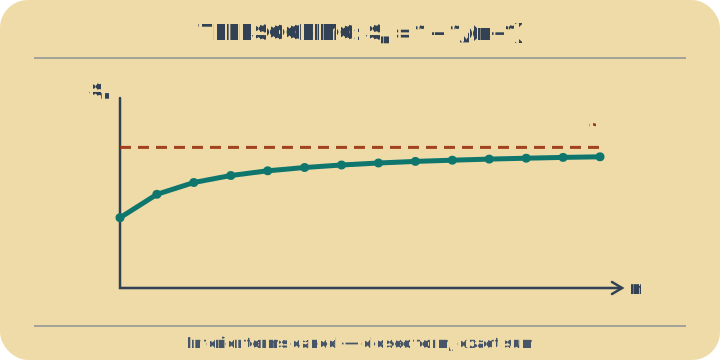
Telescoping — the middle of the sum cancels. Everything between the first and last term cancels, leaving Sₙ = 1 − 1/(n+1). The term splits into a difference f(n) − f(n+1), usually via partial fractions.
Everything between the first and last term cancels, leaving Sₙ = 1 − 1/(n+1).
References (1)

Problem solved in full

  1. The 50th partial sum of 1 + 1/2 + 1/3 + … 5 steps

    The 50th partial sum of 1 + 1/2 + 1/3 + … is 4.499, the terms are down to 0.02, and the ratio test comes back 0.98. Everything on the panel looks like convergence. Prove it diverges — and then work out how far you would have to go to reach 100.

    1. Clear the ratio test out of the way first. It compares consecutive terms, and for 1/n that ratio is (n − 1)/n, which climbs to 1 from below no matter what. The test returns inconclusive, not converges. A page that printed 0.98 without that word would be misleading by omission.

    2. The proof is Oresme's and it is seven centuries old. Group the terms into blocks ending at each power of two: 1/3 + 1/4 exceeds 1/2, the next four terms exceed 1/2, the next eight do too. Every block contributes at least a half, and there are infinitely many blocks.

    3. That settles divergence but gives no rate, and the rate is what makes divergence believable against a printed sum of 4.5. Comparing the sum with ∫dx/x supplies one: the partial sums track ln n plus a constant, and that constant is γ.

    4. Test it. ln 50 + γ = 4.489239 against the printed 4.499205, and the 0.009967 left over is the next term of the expansion, 1/2n = 0.01. The approximation is not merely close; it is close in a way that predicts its own error.

    5. So invert it. A sum of 10 needs about e^(10−γ) ≈ 12 000 terms. A sum of 100 needs e^(100−γ).

    Answer

    The tool prints 4.499205 after 50 terms and calls the series divergent, and both are true at once — which is the entire difficulty of this example. The sum grows like ln n, so it does pass every finite target eventually. Reaching 10 takes around 12 000 terms; reaching 100 takes 1.5 × 10⁴³. Divergence is a claim about eternity, not about the next few thousand terms, and 1/n is the standard proof that those are not the same thing. Switch the series to 1/n² and the same 50 terms settle at 1.625 and stay there: π²/6 is 1.645, and the entire infinite remainder is worth 0.02.

Example problems

  • Harmonic - S₅₀ = 4.499205 and still climbing — the terms reach 0.02 and the sum diverges anyway
  • Basel (π²/6) - S₅₀ = 1.625133 against π²/6, still 0.0198 short after fifty terms
  • e−1 series - S₁₅ = 1.718282, within 5.0404 × 10⁻¹⁴ of e−1 — fifteen terms, fourteen digits
  • Alt. Harmonic - S₅₀ = 0.6832472 → ln 2, and only 0.0099 off: closer than Basel at the same fifty terms
  • Geometric - S₂₀ = 0.999999, error 9.5367 × 10⁻⁷ — the one preset where the ratio test is decisive
  • Telescoping - S₃₀ = 0.9677419 → 1, error 0.0323: convergent, but the ratio test cannot show it
  • p-series - p = 2 gives ζ(2.0) and S₅₀ = 1.625133; drop p to 1 and the same series diverges