Compound Interest Explorer
watch exponential growth outrun linear intuition
Exponential accumulation and continuous compounding 🖖
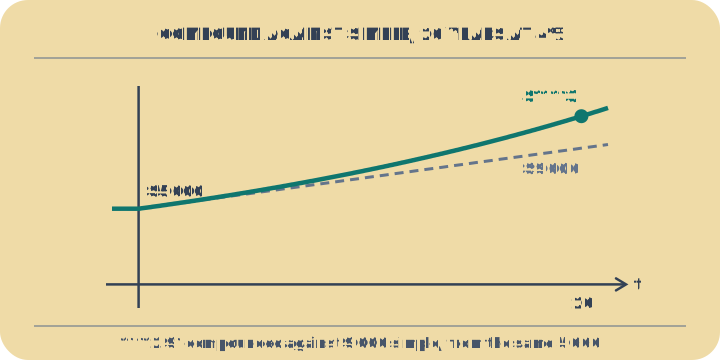
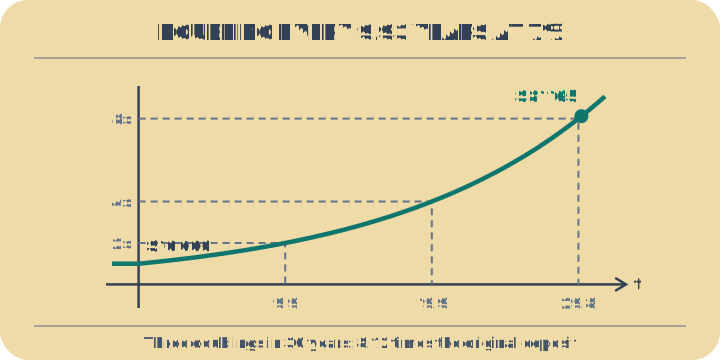
Compound interest is the addition of interest to the principal sum, causing exponential growth over time: A = P(1 + r/n)^{nt}. As the frequency of compounding n approaches infinity, the growth becomes continuous, governed by the exponential function A = P e^{rt}. This demonstrates how periodic increments scale exponentially, forming the mathematical foundation of time value of value accumulation.
Interest that earns its own interest 🖖
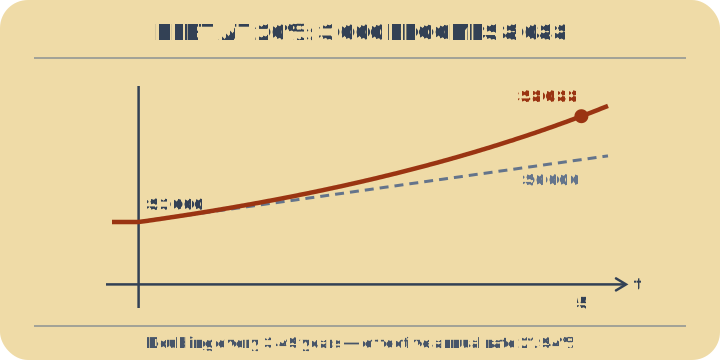
The magic of compounding is that each period's interest is added to your balance, so next period you earn interest on a bigger amount. That feedback loop is why savings accelerate instead of growing in a straight line. A handy shortcut is the Rule of 72: divide 72 by the annual percent rate to estimate how many years your money takes to double. At 6% that's about 12 years.
The number e was born here 🖖
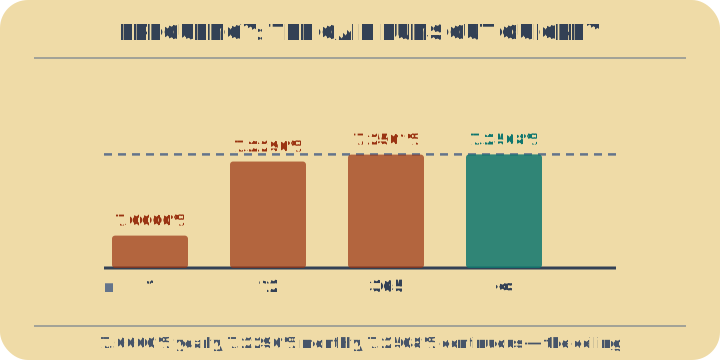
Try compounding $1 at 100% for one year. Compounded annually it becomes $2, monthly about $2.61, and daily roughly $2.71. The more often you compound, the closer the result creeps to e ≈ 2.71828. Jacob Bernoulli stumbled onto this limit in 1683 while studying compound interest — which is literally where the constant e comes from.
Example problems
- safe savings - Context: conservative savings product with relatively low annual return and long horizon.
- stock market avg - Context: long-term equity index investing where returns are higher but uncertain year to year.
- credit card debt - Context: revolving high-interest debt; this highlights how quickly balances grow if unpaid.
- daily compounding - Context: high-frequency compounding case to compare against the continuous-compounding limit.