Markup vs Margin

Markup uses cost as base; margin uses selling price as base.

Loading interactive simulation...

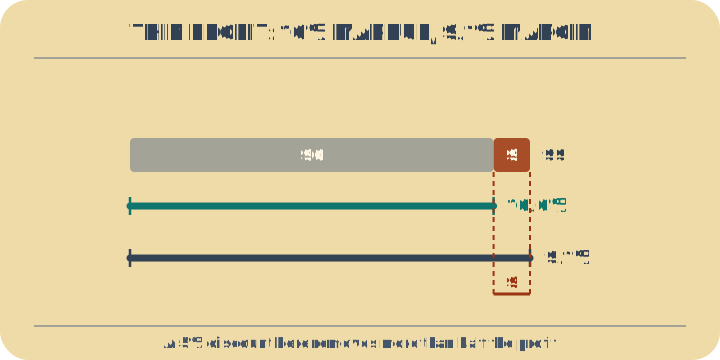
The same discount is not the same damage 🖖

Because profit is what a discount comes straight out of, the fraction of profit a price cut destroys is the discount divided by the margin β€” and that ratio moves violently between this tool's own presets. On the low-margin preset (cost 90, price 99, margin 9.1%) a 5% discount takes profit from 9.00 to 4.05: it wipes out 55% of the earnings for a 5% price change. Run the same 5% on the luxury preset (cost 200, price 950, margin 78.9%) and profit slips from 750.00 to 702.50, losing 6.3%. Same discount, 8.7 times the damage. It is why supermarkets fight over a single percentage point while a jeweller can hold a sale, and why "just knock 10% off" is a different sentence in different businesses.

Same profit, two denominators 🖖

The profit in money is identical either way β€” what changes is the base you divide it by. Markup divides that profit by the cost (what you paid), while margin divides the same profit by the selling price (what you charged). Because the price is always larger than the cost, margin is always the smaller of the two percentages. So a "40% markup" and a "40% margin" describe two different prices β€” always ask which base is meant.

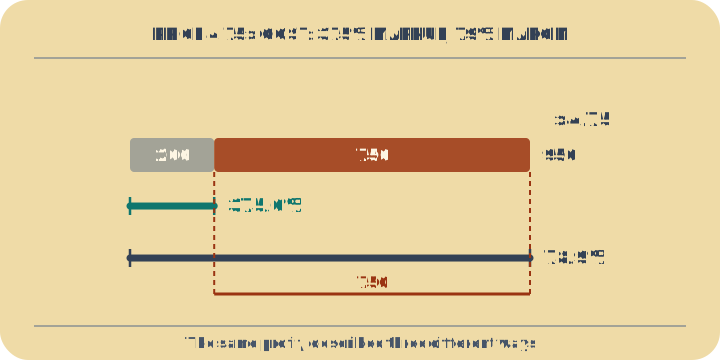
Keystone pricing hides a 2-to-1 ratio 🖖

Retailers have long used "keystone" pricing β€” simply doubling the wholesale cost. Doubling adds 100% of the cost, so it is a 100% markup, yet the very same price is only a 50% margin. A shopkeeper who "doubles their money" is really running a 50% margin, not 100%. That 2-to-1 gap is exactly why mixing up the terms wrecks budgets: quote a target margin as a markup and you silently under-price every item.

MARKUP OR MARGIN β€” THE SAME PROFIT, TWO DIFFERENT PERCENTAGES

Which Percentage Are You Quoting?

Both describe the same profit; they just divide it by different things. Markup is profit over cost β€” what you added. Margin is profit over price β€” what you kept. Markup is always the larger number, and the gap widens the more profitable the item, which is why quoting one when you meant the other is an expensive mistake rather than a pedantic one.

The everyday case β€” 50% markup is 33% margin S = C + P; P/C ≠ P/S
High profit β€” the two numbers diverge sharply P/S < 100%, P/C → ∞
Thin profit β€” the two numbers nearly coincide P ≪ C ⇒ P/C ≈ P/S
A large multiple β€” read the ratio, not the percentage S = mC ⇔ P/C = m − 1

01

The everyday case β€” 50% markup is 33% margin

What you know: Cost and price are both known, so both percentages follow. Markup divides the profit by the cost, margin divides it by the price.

Definition: S = C + P; P/C ≠ P/S

Worked example: Cost 40, price 60 β†’ profit 20. Markup = 20/40 = 50%, margin = 20/60 = 33.3%.

Open this case: retail baseline
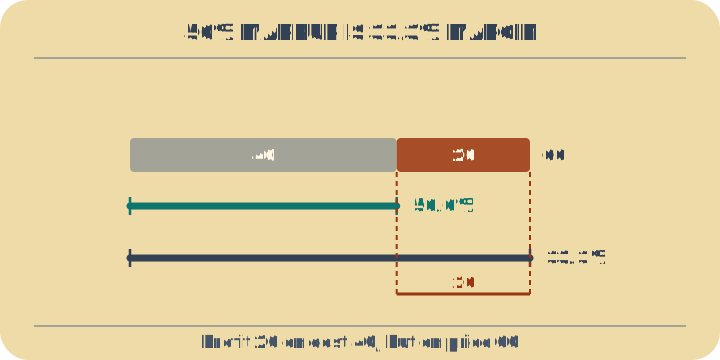
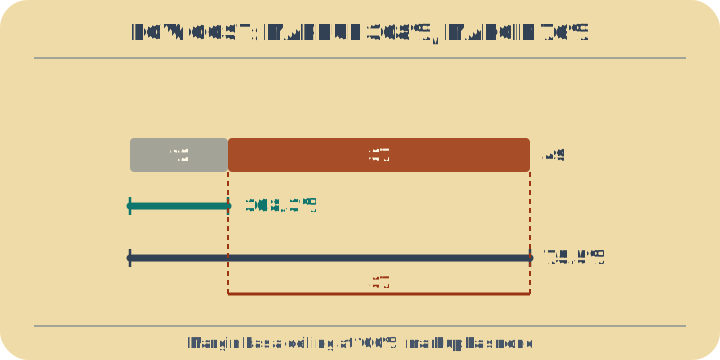
The everyday case β€” 50% markup is 33% margin. One profit, two denominators: the cost gives markup, the price gives margin. Cost and price are both known, so both percentages follow. Markup divides the profit by the cost, margin divides it by the price.
One profit, two denominators: the cost gives markup, the price gives margin.

02

High profit β€” the two numbers diverge sharply

What you know: When cost is small next to price, markup grows without limit while margin creeps towards 100%.

Definition: P/S < 100%, P/C → ∞

Worked example: Cost 12, price 49 β†’ profit 37. Markup = 308.3%, margin = 75.5%.

Open this case: high-value software
High profit β€” the two numbers diverge sharply. A small cost against a large price sends markup far past margin. When cost is small next to price, markup grows without limit while margin creeps towards 100%.
A small cost against a large price sends markup far past margin.

03

Thin profit β€” the two numbers nearly coincide

What you know: When profit is small relative to both cost and price, the two denominators are almost the same, so the percentages nearly agree.

Definition: P ≪ C ⇒ P/C ≈ P/S

Worked example: Cost 90, price 99 β†’ profit 9. Markup = 10.0%, margin = 9.1%.

Open this case: low-margin goods
Thin profit β€” the two numbers nearly coincide. With a thin profit the cost and the price are close, so both percentages are too. When profit is small relative to both cost and price, the two denominators are almost the same, so the percentages nearly agree.
With a thin profit the cost and the price are close, so both percentages are too.

04

A large multiple β€” read the ratio, not the percentage

What you know: At high profitability the percentages get unwieldy. The price-to-cost multiple is the number people actually reason with.

Definition: S = mC ⇔ P/C = m − 1

Worked example: Cost 200, price 950 β†’ profit 750. Markup = 375%, margin = 78.9%, and the price is 4.75 times the cost.

Open this case: luxury goods
A large multiple β€” read the ratio, not the percentage. The price is nearly five times the cost, which is easier to hold onto than either percentage. At high profitability the percentages get unwieldy. The price-to-cost multiple is the number people actually reason with.
The price is nearly five times the cost, which is easier to hold onto than either percentage.

Problem solved in full

  1. An item that costs 40 and sells for 60 5 steps

    An item costs 40 and sells for 60. Find the markup and the margin, show they are the same profit, and then price for a 40% margin.

    1. Both words describe the same 20 of profit. They differ only in what they divide by, and that is the entire confusion: markup is measured against cost, margin against price.

    2. Markup divides by the smaller number, so it is always the larger percentage. A shopkeeper quoting β€œ50% markup” is not making 50% of the takings.

    3. Margin divides by the price. The calculator above prints both figures side by side for exactly this reason.

    4. Because the two share a numerator, each converts to the other by a fixed relation. Markup is unbounded β€” a 900% markup is possible β€” while margin can never reach 100%, since profit cannot exceed the price.

    5. Now price backwards from a target margin. The mistake is to add 40% to cost, which gives 56 and a margin of only 28.6%. Divide instead.

    Answer

    50% markup, 33.33% margin, one profit of 20. To hit a 40% margin you need a price of 66.67, which is a 66.7% markup β€” not 40%. Adding the target margin to cost is one of the most expensive arithmetic errors in retail: applied here it undercharges by 10.67 per unit and silently misses the margin by more than a quarter. The fix is one line: divide by (1 βˆ’ margin), never multiply by (1 + margin).

References (1)

Example problems

  • retail baseline - Retail example: markup is 50% while margin is 33.3%.
  • high-value software - High-value software can show very large markup and margin.
  • low-margin goods - Low-margin products require volume to generate strong total profit.
  • luxury goods - A luxury item at four to five times cost β€” the markup and the margin are the same profit measured against two different bases, and they diverge sharply here