Lewis Structure & VSEPR Molecular Lab

Build molecules by selecting central atoms, adding ligands, and placing lone pairs. Drag to rotate the 3D VSEPR shape and observe how lone pairs distort bond angles.

Loading interactive simulation...

Valence shells and spatial minimizing 🖖

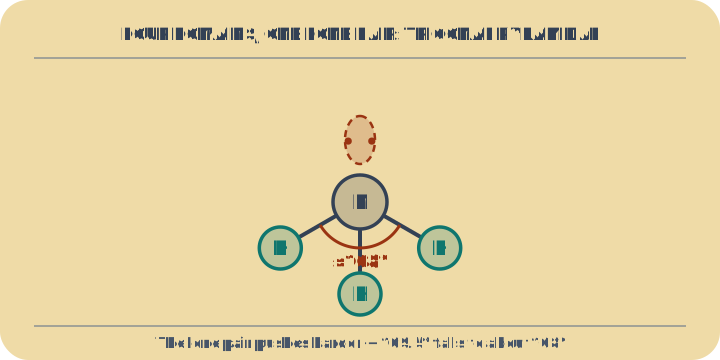
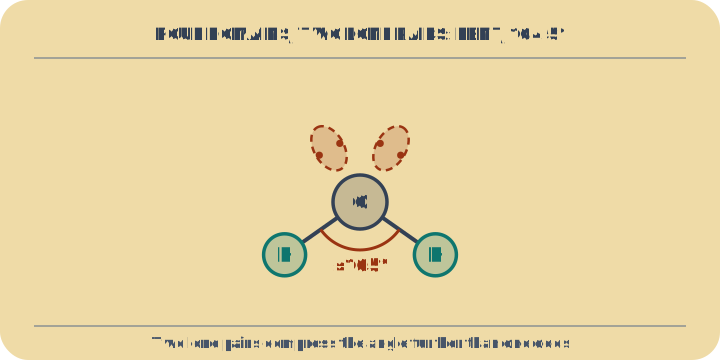
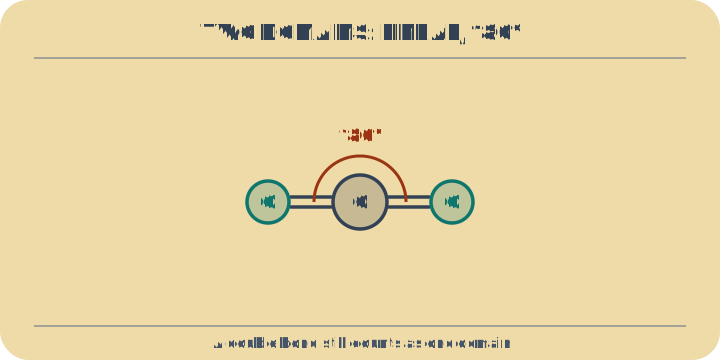
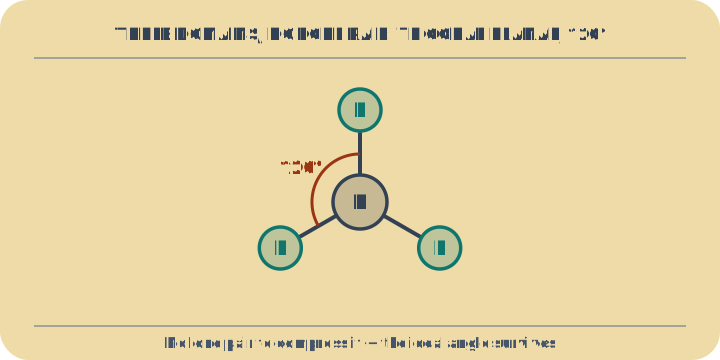
VSEPR (Valence Shell Electron Pair Repulsion) theory explains molecular shapes by assuming that electron pairs in the valence shell of a central atom repel each other. To minimize electrostatic repulsion, these electron pairs arrange themselves in space to maximize their separation, defining geometries like linear, tetrahedral, and octahedral. A critical detail is that non-bonding lone pairs occupy more space than bonding pairs, because they are held close to a single nucleus rather than shared between two. This pushes adjacent chemical bonds closer together, distorting ideal bond angles. For example, water has a tetrahedral electron geometry, but the repulsion from its two lone pairs squeezes the H-O-H bond angle down from the ideal 109.5° to 104.5°.
From flat dots to real shape 🖖

This lab turns a flat Lewis diagram into the 3D shape a molecule actually takes. The recipe is pure counting: add the atoms bonded to the central atom to its lone pairs to get the steric number, and that single number predicts the geometry. Invisible lone pairs count just as much as visible atoms — methane (CH4) and ammonia (NH3) both have a steric number of 4, but ammonia swaps one bond for a lone pair, tipping the flat-looking tetrahedron into a pyramid.

The d-orbital myth of hypervalency 🖖

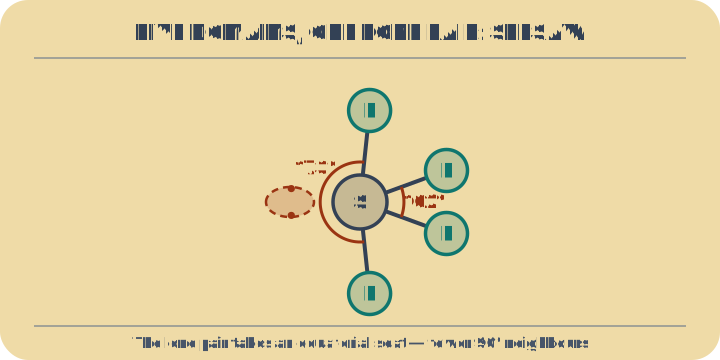
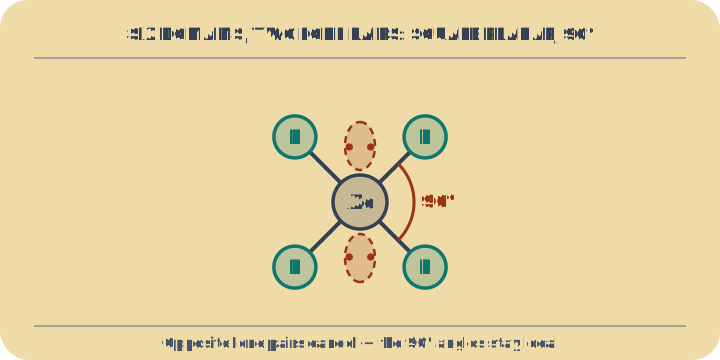
Build SF4 or XeF4 and the lab reports sp3d or sp3d2 hybridization — the textbook story for a central atom holding more than eight electrons. Yet computational chemistry has largely debunked it: the d-orbitals of sulfur and xenon sit far too high in energy to contribute meaningfully. These hypervalent molecules are better described by 3-center-4-electron bonds spread across the ligands, so the tidy sp3d label you see is more a useful teaching fiction than physical reality.

Example problems