2D Eigenvector Explorer
matrix action on basis vectors and transformed unit circle
eigenstructure is the transform fingerprint 🖖
Trace and determinant constrain eigenvalues globally, while eigenvectors define invariant subspaces. Together they form a minimal dynamic fingerprint of the linear map.
the arrows that refuse to turn 🖖
Apply the matrix to most vectors and they swing to a brand-new direction. Eigenvectors are the special ones that stay on their own line โ the transform only stretches or shrinks them by a number, the eigenvalue, and may flip them 180ยฐ. Concrete takeaway: put a vector on a green eigenvector line and every transform keeps it pointing along that line, so those lines are the map's fixed skeleton.
Google was built on a giant eigenvector 🖖
The same idea powers Google's original PageRank. Treat the entire web as one enormous matrix of links, and the rank of every page is essentially the dominant eigenvector โ the single invariant direction that survives endless random clicking. What you nudge here in 2D is the toy version of a calculation once run across billions of pages. Eigenvector centrality scores influence in social networks the very same way.
Example problems
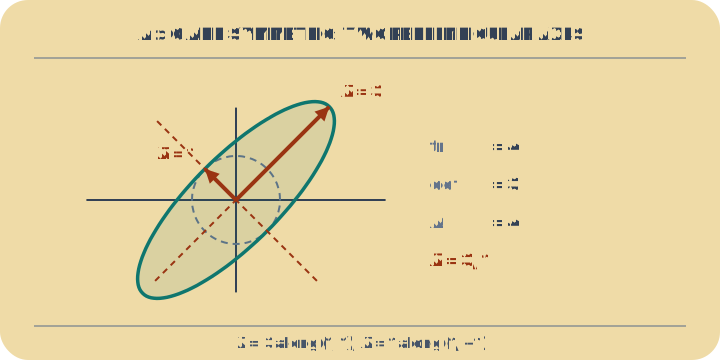
- symmetric stretch - Symmetric matrix has two real orthogonal eigendirections.
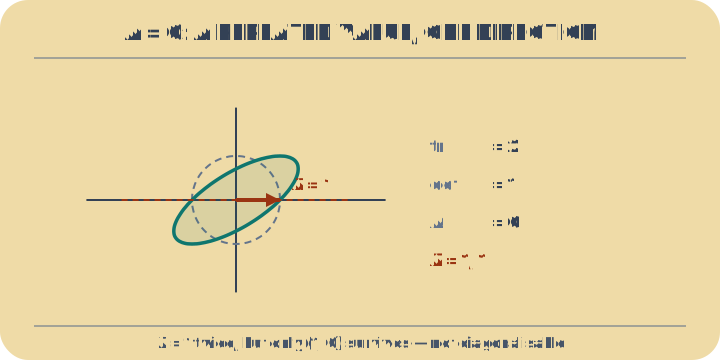
- shear only - Shear matrix has repeated eigenvalue with one dominant eigendirection.
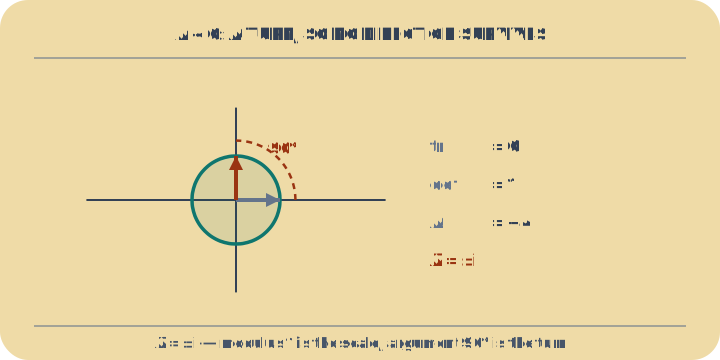
- rotation - Pure rotation has complex eigenvalues and no real eigenvectors.
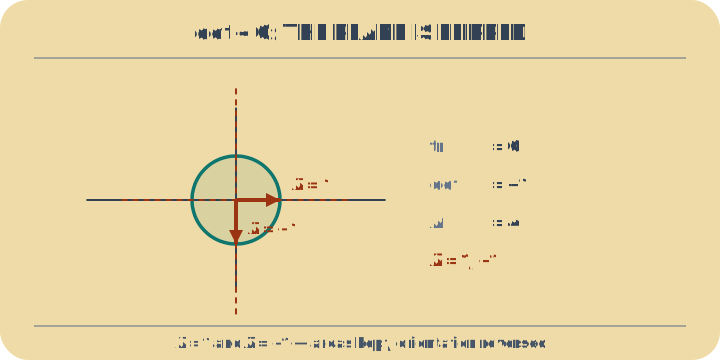
- reflection - Reflection flips one axis and keeps the other.
- anisotropic stretch - anisotropic stretch
- swap axes - swap axes