Matrix Transformation Visualiser

Enter a 2×2 matrix and see how it transforms the coordinate plane.

Loading interactive simulation...

A determinant of zero destroys information 🖖

The determinant is not only an area scale factor — its value tells you whether the transformation can be undone at all. Negative means the plane was flipped over, so a shape traced clockwise comes out anticlockwise. Zero means the entire plane has been crushed onto a single line, and that is fatal: countless different starting points now sit at the same destination, so no rule could ever send them back where they came from. This is exactly why a matrix with determinant 0 has no inverse. Squashing is the one thing a linear map can do that cannot be reversed.

The columns tell you everything 🖖

A 2×2 matrix is really just instructions for two arrows. Its first column shows where the arrow (1, 0) lands, and its second column shows where (0, 1) lands. Because straight lines stay straight and the grid stays evenly spaced, those two destinations fix where every other point goes. To predict any transformation, just read its columns.

Rotations have no favourite direction 🖖

Stretches and shears keep at least one line pointing its original way — an eigenvector. A pure rotation, though, tilts every direction, so it has no real eigenvectors at all; its eigenvalues are the complex pair cos θ ± i·sin θ. That is exactly the e that multiplies complex numbers — rotating the plane and multiplying by a unit complex number are the same operation.

LINEAR MAPS — READING A 2×2 MATRIX BEFORE YOU MULTIPLY ANYTHING

What Does This Matrix Do to the Plane?

Every 2×2 matrix moves the whole plane at once, and its columns say how: column one is where (1, 0) lands, column two is where (0, 1) lands. The determinant then reports what happened to area and orientation, and the eigenvectors name the directions that came out pointing the way they went in. Five patterns cover almost everything you will be handed.

Rotation — every direction turns, nothing stretches [cosθ −sinθ; sinθ cosθ]
Scaling — each axis stretched by its own factor [k₁ 0; 0 k₂], det = k₁k₂
Shear — one line holds still while the rest slide [1 k; 0 1], det = 1
Reflection — the plane is flipped over a mirror line det = −1
Singular — the plane is flattened onto a line det = 0

01

Rotation — every direction turns, nothing stretches

What you know: The columns are perpendicular unit vectors, and the second is the first turned a quarter turn anticlockwise. det = +1, so area and orientation are both untouched.

Matrix: [cosθ −sinθ; sinθ cosθ]

Worked example: θ = 45° → [0.707 −0.707; 0.707 0.707] → (1, 0) lands on (0.707, 0.707), and every length stays what it was

Open this case: Rotate 45°
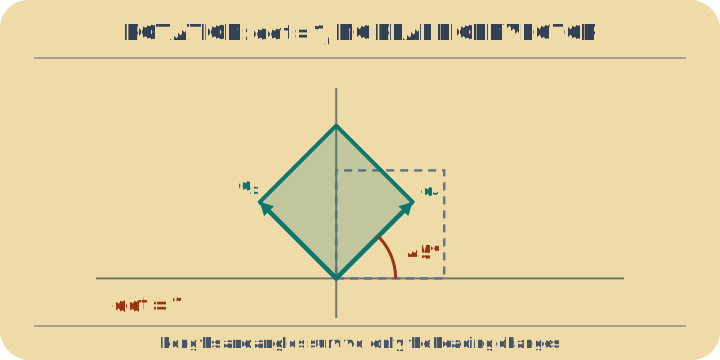
Rotation — every direction turns, nothing stretches. The unit square keeps its size and shape and arrives tilted by 45°. The columns are perpendicular unit vectors, and the second is the first turned a quarter turn anticlockwise. det = +1, so area and orientation are both untouched.
The unit square keeps its size and shape and arrives tilted by 45°.

02

Scaling — each axis stretched by its own factor

What you know: The matrix is diagonal: both off-diagonal entries are zero. Each axis is multiplied by its own number, and det = k₁·k₂ is the area factor.

Matrix: [k₁ 0; 0 k₂], det = k₁k₂

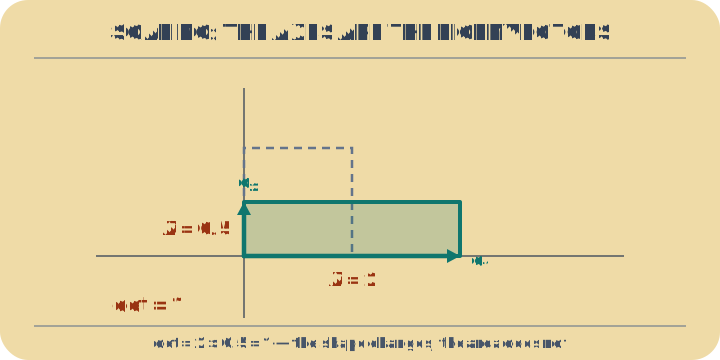
Worked example: [2 0; 0 0.5] → x doubles and y halves → det = 2 × 0.5 = 1, so the area is unchanged although the shape is not

Open this case: Scale
Scaling — each axis stretched by its own factor. The square becomes a rectangle: twice as wide, half as tall, same area. The matrix is diagonal: both off-diagonal entries are zero. Each axis is multiplied by its own number, and det = k₁·k₂ is the area factor.
The square becomes a rectangle: twice as wide, half as tall, same area.

03

Shear — one line holds still while the rest slide

What you know: Both diagonal entries are 1 and exactly one off-diagonal entry is non-zero. det = 1, so area survives, but nothing here is rigid.

Matrix: [1 k; 0 1], det = 1

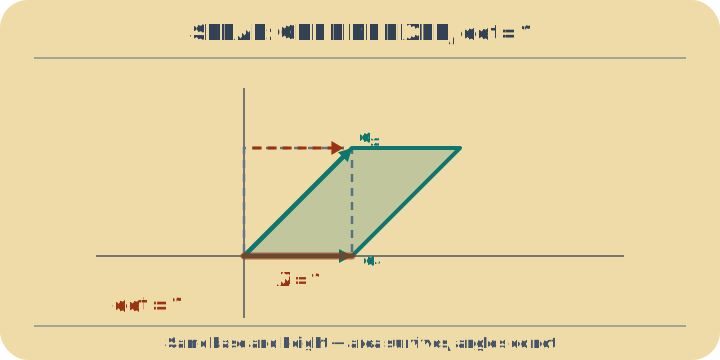
Worked example: [1 1; 0 1] → (1, 0) stays put and (0, 1) slides to (1, 1) → the square leans into a parallelogram of the same area

Open this case: Shear
Shear — one line holds still while the rest slide. Base fixed, top slid across: same base, same height, so the same area. Both diagonal entries are 1 and exactly one off-diagonal entry is non-zero. det = 1, so area survives, but nothing here is rigid.
Base fixed, top slid across: same base, same height, so the same area.

04

Reflection — the plane is flipped over a mirror line

What you know: det = −1. The size of it, 1, says area is preserved; the minus sign says orientation is reversed.

Matrix: det = −1

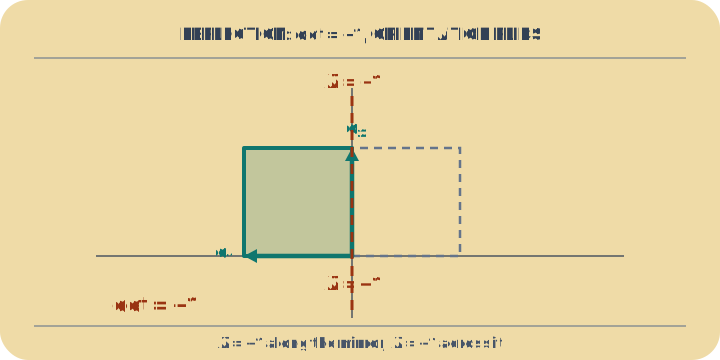
Worked example: [−1 0; 0 1] → (1, 0) becomes (−1, 0) while (0, 1) stays → every point is mirrored across the y-axis

Open this case: Reflect
Reflection — the plane is flipped over a mirror line. The square lands on the far side of the mirror, with its corners in reverse order. det = −1. The size of it, 1, says area is preserved; the minus sign says orientation is reversed.
The square lands on the far side of the mirror, with its corners in reverse order.

05

Singular — the plane is flattened onto a line

What you know: det = 0: the two columns are multiples of each other, so they point along one line. The matrix has no inverse.

Matrix: det = 0

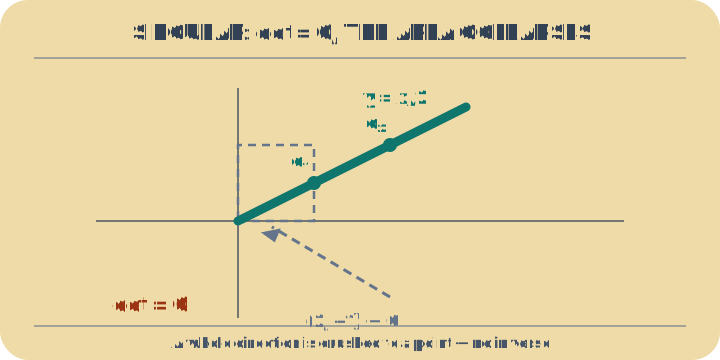
Worked example: [1 2; 0.5 1] → det = 1·1 − 2·0.5 = 0 → the whole plane lands on the line y = x/2, and the direction (2, −1) is crushed onto the origin

Open this case: Singular
Singular — the plane is flattened onto a line. The square has no area left: every point sits on one line through the origin. det = 0: the two columns are multiples of each other, so they point along one line. The matrix has no inverse.
The square has no area left: every point sits on one line through the origin.

Problem solved in full

  1. The identity matrix and a shear with identical eigenvalues 5 steps

    The identity matrix and a shear print the same determinant, the same trace, and the same pair of eigenvalues. All four rows above are identical for both. Prove the matrices differ anyway — using the same eigenvalue machinery that just failed to separate them.

    1. Both have determinant 1 and trace 2. For the identity that is obvious. For the shear it says something real: sliding the plane sideways in proportion to height preserves every area, which is why the parallelogram in the picture changes shape without changing size.

    2. The characteristic polynomial is assembled from precisely those two numbers, so it cannot separate them either. Both give (λ − 1)², a repeated root at 1. Two different matrices, one spectrum.

    3. Eigenvalues are where most courses stop. Eigenvectors are where these two part. For the identity, A − λI is the zero matrix, so the equation is satisfied by every vector in the plane.

    4. For the shear, A − λI has one surviving entry and it forces y = 0. Only the horizontal axis is fixed — a line, not a plane.

    5. That difference has a name and a consequence. The shear's eigenvalue has algebraic multiplicity 2 but geometric multiplicity 1, which makes the matrix defective: there is no basis of eigenvectors, so it cannot be diagonalised. Its powers march off linearly while the identity's sit still.

    Answer

    Every figure the tool prints — det = 1.0000, tr = 2.0000, λ = 1.000, 1.000 — is shared by both matrices. Set b to 1 and watch the readout refuse to move while the grid visibly slides. The invariants are not incomplete by accident: determinant and trace are two numbers and a 2×2 matrix has four, so two degrees of freedom have to go missing somewhere. What they cannot see is the dimension of the eigenspace, 2 against 1 — and that is exactly what decides whether Aⁿ stays put or grows without bound. It is why "find the eigenvalues" is never the whole instruction.

Learning path

Matrices that move things

Leads to Eigenvectors

References (1)

Example problems

  • Rotate 45° - det(A) = 0.9997, not 1 — a rotation should preserve area exactly, and the shortfall of 3 parts in 10000 is the typed 0.707 rather than the geometry
  • Shear - det(A) = 1.0000 with eigenvalues 1.000, 1.000 — area untouched, and a repeated eigenvalue leaves only one invariant direction
  • Scale - Stretch by 2 and squash by 0.5 and det(A) = 1.0000: a scaling that changes every length and no area
  • Reflect - det(A) = −1.0000 — the same area, traversed the other way round; eigenvalues 1.000 and −1.000 are the mirror line and its normal
  • Singular - det(A) = 0.0000 and the page says SINGULAR: eigenvalue 0.000 is the direction the plane is crushed along