Inverse Functions Explorer

Pick a function, move a point on f, and watch its mirrored inverse point. Restrict domain for non-injective cases.

Loading interactive simulation...

Bijective Mapping Reversibility 🖖

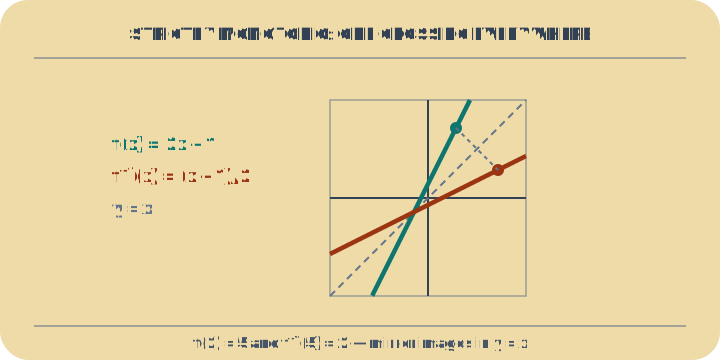
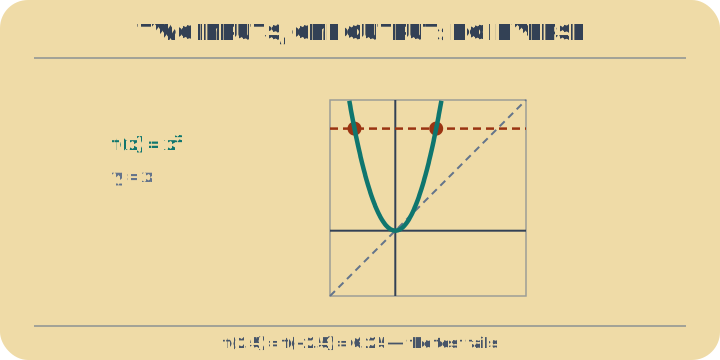
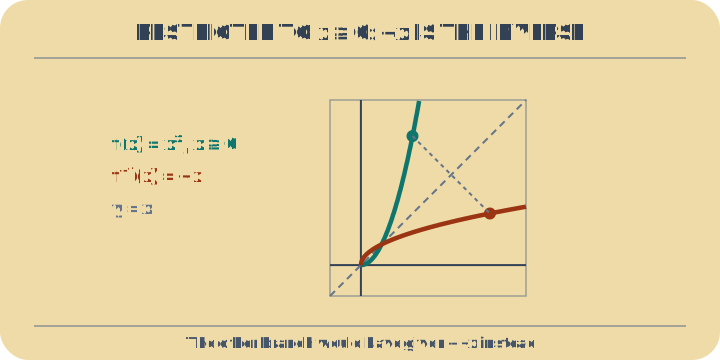
An inverse function mathematically undoes a transformation, mirroring the curve strictly across the axis y=x. Absolute geometric symmetry is guaranteed only if the origin function satisfies strict bijective injectivity (passing the horizontal line test), explicitly demanding domain restrictions for functions like squaring.

The undo button, and how to test it 🖖

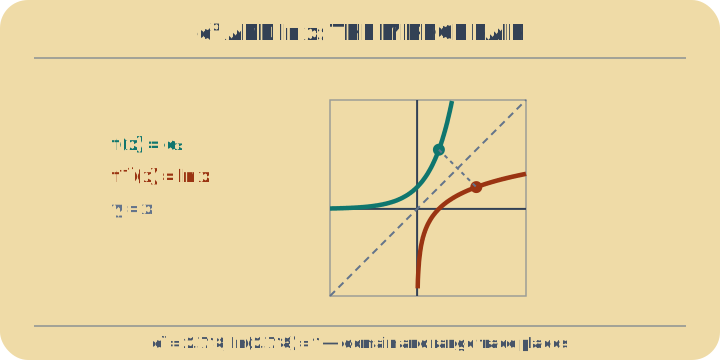
An inverse function is an undo button: feed f's output back through f⁻¹ and you land on your starting x. To find one, swap x and y in the equation and solve — that swap is exactly why the two graphs mirror across the line y=x. The surest check is composition: if f(f⁻¹(x)) = x and f⁻¹(f(x)) = x, you truly have a matched pair. Converting Celsius to Fahrenheit and back is the same idea in daily life.

Functions that are their own inverse 🖖

Most curves look nothing like their mirror image across y=x, but a rare few land exactly on top of themselves. These are involutions, functions satisfying f(f(x)) = x — they are their own inverse. The reciprocal f(x) = 1/x is the classic case: its hyperbola is already symmetric about y=x, so reflecting it changes nothing. The same self-undoing trick powers ROT13, where scrambling text twice restores the original.

Example problems