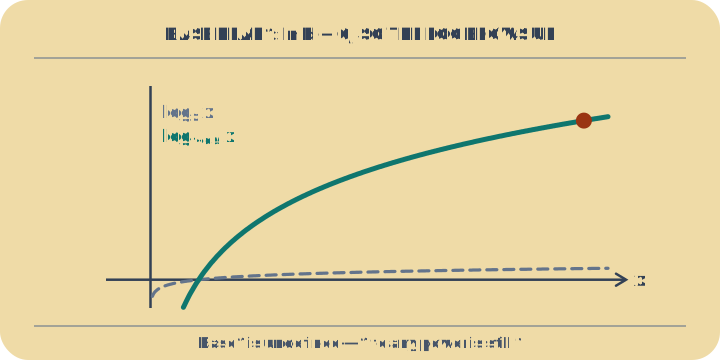
A logarithm is an exponent. log_b(x) is the power you have to raise b to in order to get x — so log_b(x) = y and by = x are one statement read in two directions.
What each symbol means
b- the base — the number being raised to a power. Any positive value except 1: raising 1 to a power only ever gives 1, so it could never reach a different x.
x- the argument — the value you are trying to reach. It has to be positive, because no real power of a positive base ever lands on zero or below it.
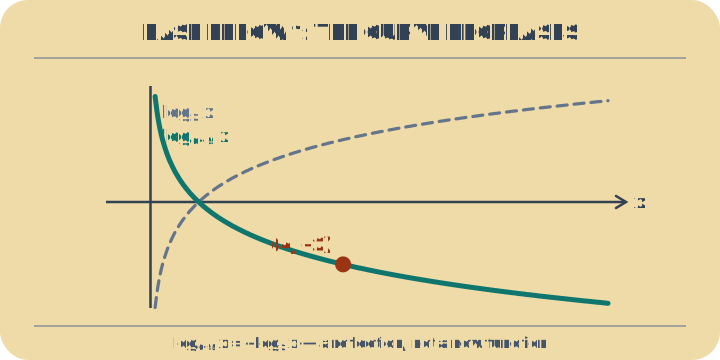
y- the answer, which is the exponent itself. This one is unrestricted. It is exactly 0 when x is 1 whatever the base, and for a base above 1 it is negative below x = 1 and any size above it. Below base 1 the two halves swap, which is the halfBase case.
Where the formula comes from
- Start from the definition. If
log_b(x) = y, then by = x.
- Take the natural logarithm of both sides — whatever you do to one side you do to the other:
ln(by) = ln(x).
- The power rule pulls the exponent out in front,
ln(by) = y·ln(b), which leaves y·ln(b) = ln(x).
- Divide by
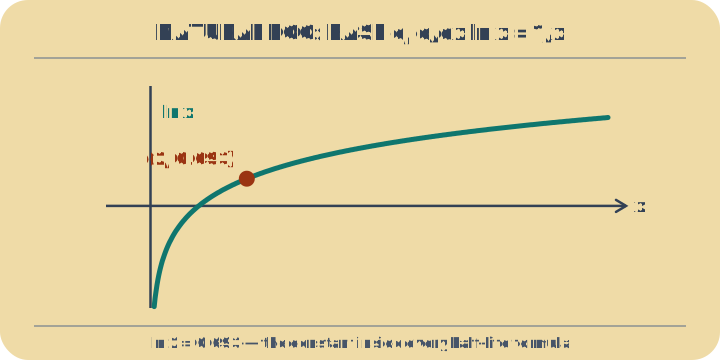
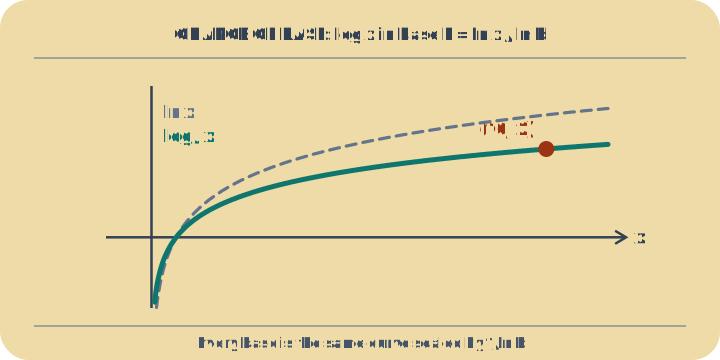
ln(b): y = ln(x) / ln(b). That is the change-of-base rule, and it is the line printed in the panel above — at base 2 with x = 2 it reads 0.69 / 0.69 = 1.
How to read what you see
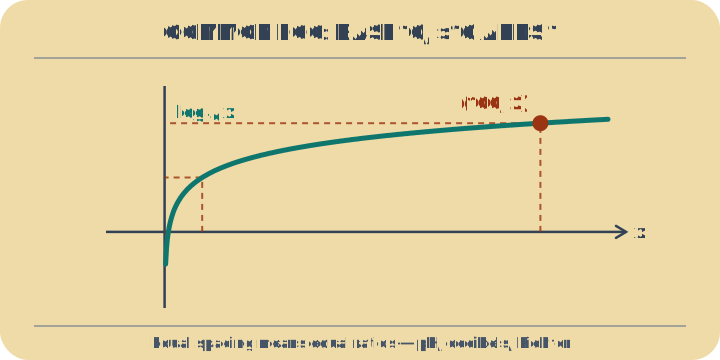
Three curves are drawn: your curve for the base you picked, plus ln(x) and log₁₀(x) as fixed references you can measure against. All three pass through the small dot at (1, 0), because any base raised to the power 0 gives 1. The larger dot sits where the argument equals the base, at (b, 1), so it slides along the curve as you drag the base. Hovering anywhere on the graph reports all three logarithms at that exact x.
- Assumes
b > 0, b ≠ 1, and x > 0. These are not bookkeeping conventions — they are exactly the conditions under which "b to what power gives x?" has one real answer.
- Breaks when
- Base 1 is the interesting failure, and step 4 shows why: the derivation divides by
ln(b), and ln(1) = 0, so the value is undefined rather than merely large. You cannot sit there — type 1 into the base and it is replaced by 0.99, where the change-of-base line divides by a value near −0.01 and the answer leaps to −68.97 for the same x = 2. Below 1 that divisor stays negative and the whole curve turns over: still a logarithm, now decreasing.