Rational Functions Explorer
move zero/pole/gain and watch branch geometry change
Pole and Zero Analysis 🖖
Rational functions expose the tension between numerator roots (zeros) and denominator roots (poles). As inputs approach a pole, the function mathematically detonates towards infinity. The ratio of leading high-degree polynomials rigidly dictates horizontal asymptotes representing extreme asymptotic limits.
Every curve here is a hyperbola 🖖
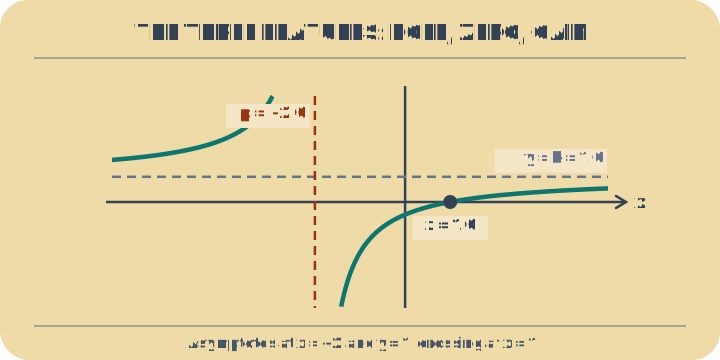
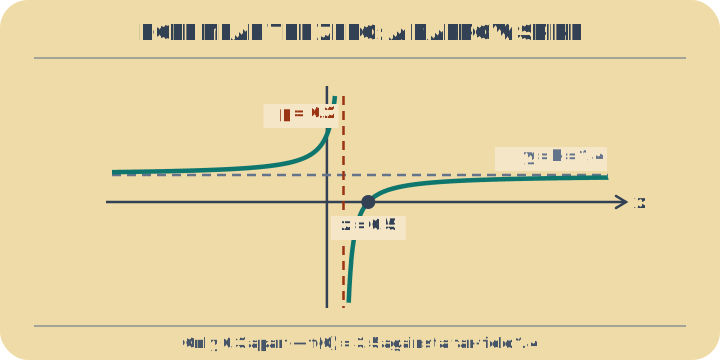
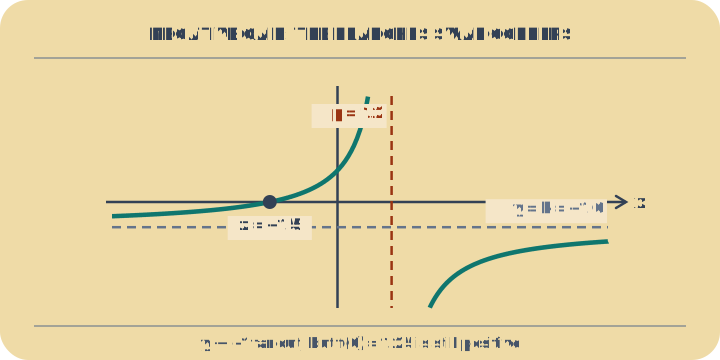
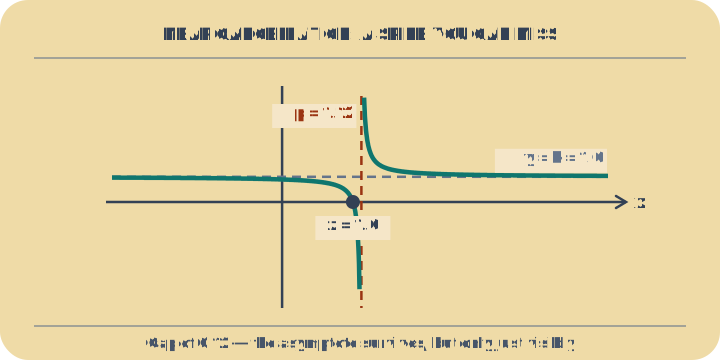
The tool computes f(x)=k(x−z)/(x−p): the distance from a zero divided by the distance from a pole, scaled by k. Whichever values you pick, the graph keeps the same shape — a hyperbola, the very curve that y=1/x draws. Sliding z and p only shifts it; changing k stretches it and flips which way the two branches open. Takeaway: master y=1/x and you have mastered them all.
A pole is only infinite by choice 🖖
Written as (ax+b)/(cx+d), any one-zero one-pole function is a Möbius transformation — the maps that rule complex analysis and hyperbolic geometry. Add a single point at infinity (the Riemann sphere) and the pole stops being a catastrophe: x=p simply maps to that new point, and x=∞ maps to the horizontal asymptote y=k. On the sphere the function is a smooth, reversible bijection — the "explosion" is just an artifact of the flat map.
Example problems
- basic - Basic one-zero one-pole shape with clear asymptotes.
- steep pole - Pole near the origin creates strong local divergence.
- negative gain - Negative gain flips branch orientation across asymptotes.
- near cancel - Near-zero/pole cancellation mimics a removable-like behavior locally.