Taylor Series Explorer
local approximation with degree and center controls
why Taylor is local, not global 🖖
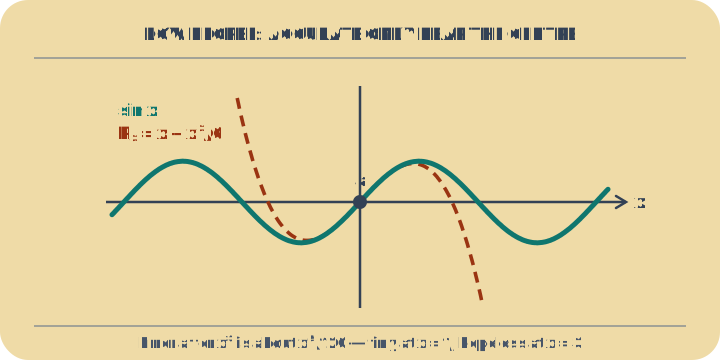
A Taylor polynomial is built from derivatives at one point, so it captures the function's local geometry there. Farther away, the same coefficients can stop describing the function well: the error depends on smoothness, degree, and radius of convergence.
Matching a curve one derivative at a time 🖖
This tool rebuilds a curvy function using nothing but additions, multiplications, and powers — the arithmetic a processor can actually do. The degree-0 term matches the function's height at the center, degree 1 matches its slope, degree 2 its bend, and each higher term pins down one more derivative. Raise the degree n and watch the dashed polynomial peel closer to the solid curve near the center point a.
When smoothness still isn't enough 🖖
You might expect that an infinitely smooth function is always captured by a high-enough-degree Taylor polynomial — but it isn't guaranteed. The classic counterexample is f(x)=e−1/x² (with f(0)=0): every derivative at 0 equals zero, so its Taylor polynomial around 0 is just 0 at every degree, yet the function is positive everywhere else. Adding terms never helps. Being 'smooth' (all derivatives exist) is weaker than being 'analytic' (actually equal to your own series).
Example problems
- sin near 0 - Low-degree sin expansion is accurate near x=0.
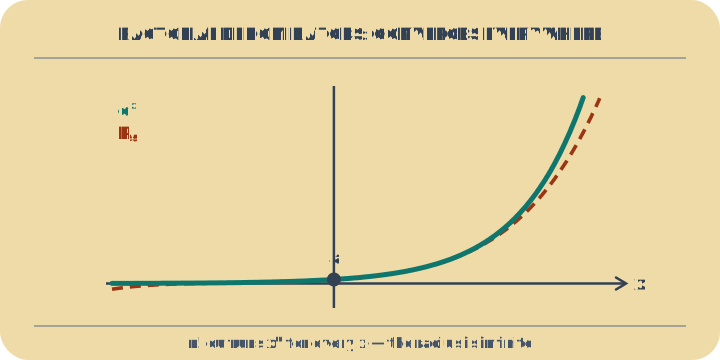
- exp fast - Exponential Taylor series converges quickly around 0.
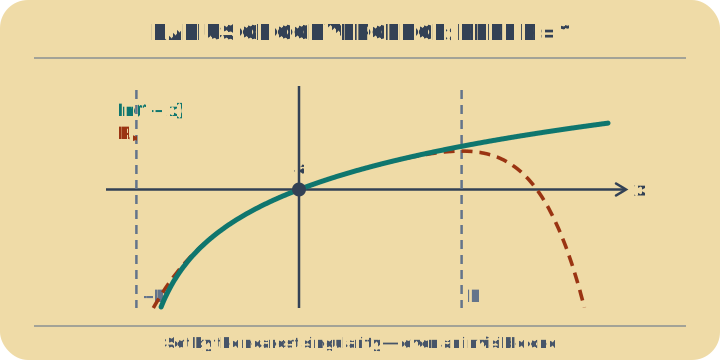
- ln edge - Logarithm series loses accuracy near radius edge.
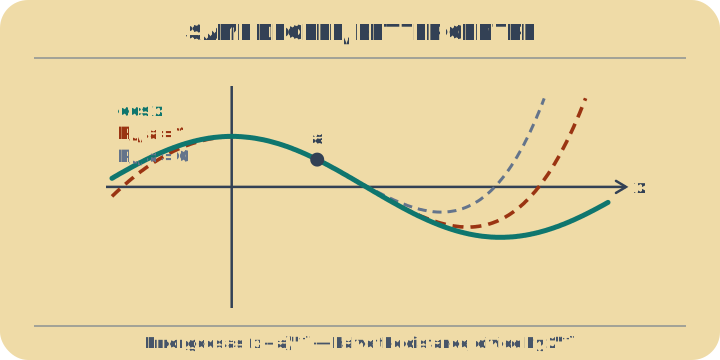
- shifted center - Changing expansion center improves local fit elsewhere.