01
SSS - three sides
What you know: All three side lengths: a, b, and c.
Method: c2 = a2 + b2 − 2ab cos C
Worked example: a = 3, b = 4, c = 5 produces a right triangle.
Open this case: SSS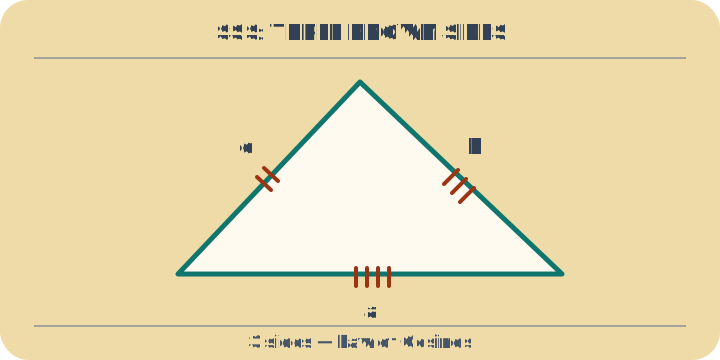
Interactive Math & Science Lessons
Triangle Theory — Case by Case
Start with the values marked as known. Their pattern—not the triangle's appearance—chooses the method. A solvable triangle needs at least one known side.
01
What you know: All three side lengths: a, b, and c.
Method: c2 = a2 + b2 − 2ab cos C
Worked example: a = 3, b = 4, c = 5 produces a right triangle.
Open this case: SSS
02
What you know: Two sides and the angle included between them.
Method: c2 = a2 + b2 − 2ab cos C
Worked example: a = 7, b = 5, C = 60° fixes the opposite side c.
Open this case: SAS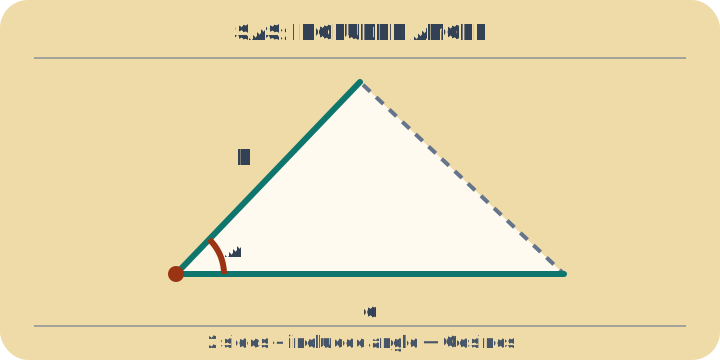
03
What you know: Two angles and any one side (ASA or AAS).
Method: C = 180° − A − B; a / sin A = c / sin C
Worked example: A = 40°, B = 75°, c = 8 gives C = 65° before solving the sides.
Open this case: ASA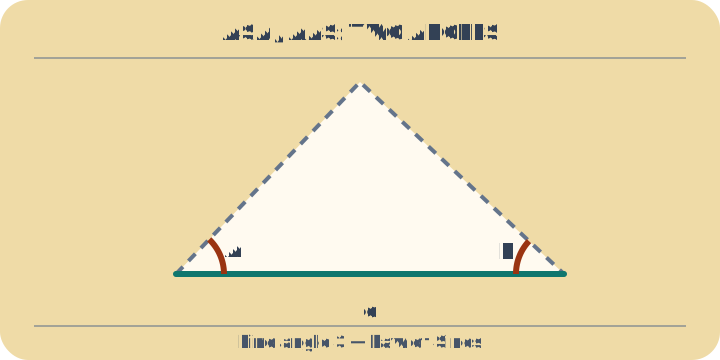
04
What you know: Two sides and a non-included angle opposite one of them.
Method: sin B = b sin A / a; B′ = 180° − B
Worked example: a = 7, b = 9, A = 40° creates two valid triangles.
Open this case: SSA ambiguous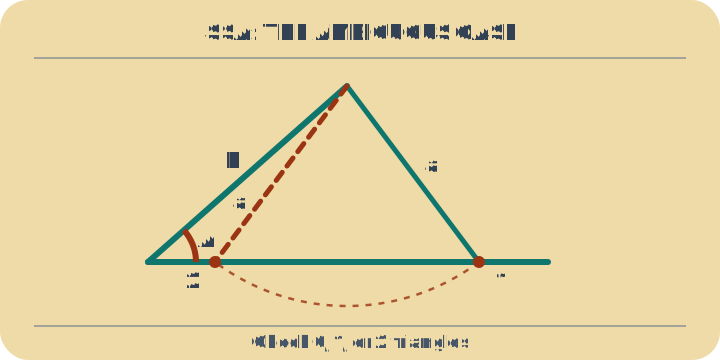
05
What you know: All three angles, but no side length.
Method: A + B + C = 180° ⇒ ∞ △
Worked example: 30°, 60°, 90° describes infinitely many triangles of different sizes.
AAA needs a side — open ASA/AAS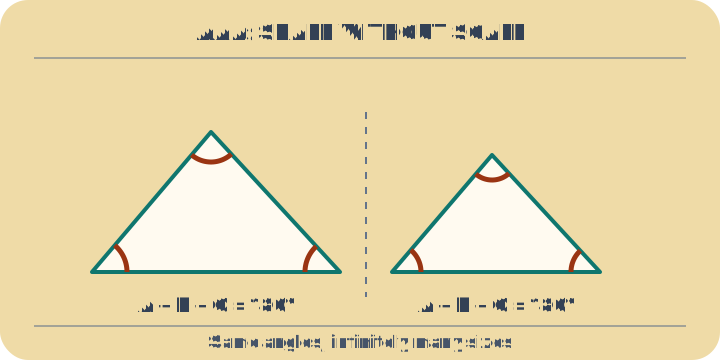
The 3-4-5 triangle has a right angle, and nobody has to be told which corner it is in. Solve it from the three sides alone, then find the two circles hiding in it. This is the SSS case.
With three sides and no angles, the only way in is the cosine law, rearranged to give the cosine of the angle opposite the side you leave on the left.
Repeat for the second angle. Nothing here is an approximation yet — 0.8 and 0.6 are exact, and the decimals only appear when the arccosine is taken.
The third angle is free, from the angle sum. Run the cosine law on it anyway and the numerator is 9 + 16 − 25 = 0, so the cosine is exactly zero: this triangle is right-angled because 3² + 4² happens to equal 5², and for no other reason.
Heron's formula needs only the perimeter and the three sides. It returns 6, which is also ½ × 3 × 4 — the two formulas must agree, and here you can watch them do it.
Two radii the panel never mentions. In a right triangle the hypotenuse is a diameter of the circumscribed circle, so R = 2.5. The inscribed circle has r = (a + b − c)/2 = 1, and the area equals r × s, which is 6 again.
Answer
The tool prints A = 36.8699°, B = 53.1301°, C = 90° and a perimeter of 12. Step 3 is the one to keep: Pythagoras is not a separate theorem sitting beside the cosine law, it is the cosine law evaluated at 90°, where the −2ab·cos C term vanishes. Everything the right angle is famous for comes from that single term going to zero, which is why the cosine law works on every triangle and Pythagoras works on one kind.
Two sides of 7 and 5 with a 60° angle between them. Find the third side and both remaining angles — and take the second angle from the cosine law rather than the sine law, on purpose. This is the SAS case.
The known angle sits between the two known sides, which is exactly the arrangement the cosine law is built for: it returns the side opposite that angle.
At 60° the cosine is exactly ½, so the whole −2ab·cos C term collapses to −ab and the expression becomes a² + b² − ab. That is a useful shape to recognise; 60° is the only angle where it appears.
Now for angle A. The sine law would work and is easier to type, but arcsine returns an angle in the first quadrant and its supplement is equally valid — so it would hand back two candidates and no way to choose. The cosine law returns a signed cosine, and cosine is one-to-one across the whole range an angle of a triangle can take.
The last angle comes from the angle sum, which cannot be ambiguous.
The area needs neither of the angles you just found, nor the third side: two sides and the angle between them are already enough.
Answer
The tool prints c = 6.245, A = 76.1021° and B = 43.8979°. Step 3 is why SAS is a safe case and SSA is not. The cosine law can never be ambiguous, because cos θ takes each value once between 0° and 180°; the sine law always can be, because sin θ takes each value twice. When two sides and an included angle are given, the triangle is already determined and the arithmetic simply reads it off. The next problem is what happens when it is not.
a = 7, b = 9, A = 40° — and the panel says two solutions while printing one triangle. Find the other one. This is the SSA case.
Drop a perpendicular from the far vertex onto the line the known angle sits on. Its length is h = b·sin A = 5.7851, and the side a has to reach that line: too short and there is no triangle, exactly h and there is one, longer than h and there are two — until a exceeds b, when the second closes off. Here h < a < b, so two.
The sine law gives the sine of B, and arcsine returns the acute branch.
The obtuse branch has the same sine. It survives only if it still leaves room for a third angle, and 40° + 124.2651° is under 180°, so it does.
Complete the first triangle: third angle, then the third side by the sine law, then the area.
Complete the second the same way. Same a, same b, same A — and a triangle less than a third the size.
Answer
The panel reports SSA (2 solutions) and prints h = 5.7851, B = 55.7349°, c = 10.8356 and an area of 31.3423 — the first branch. The second, with c = 2.9532 and area 8.5424, is left for you, and that is the honest state of the case: the data does not determine the triangle, so no calculator can hand you the answer. Anything measured this way — a bearing and two distances, a radar range with an off-axis angle — carries the same fork, and the way out is never more arithmetic. It is one more measurement, or a physical reason why one of the two is impossible.
Learning path