Unit Circle Explorer
sin, cos & tan - visualized on the unit circle
Orthogonal Projection Geometry 🖖
The unit circle fundamentally unifies algebraic trigonometry and analytical geometry. It isolates the pure orthogonal projections of angular momentum. The sine and cosine operate as continuous parametric coordinates mapping the boundless periodic real numbers onto a finite, closed dimensional loop.
Where the coordinates are the answer 🖖
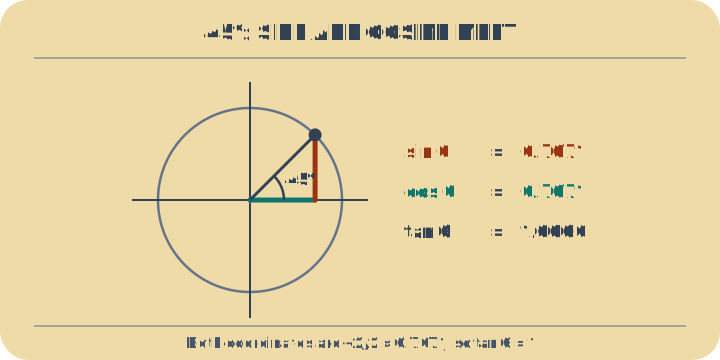
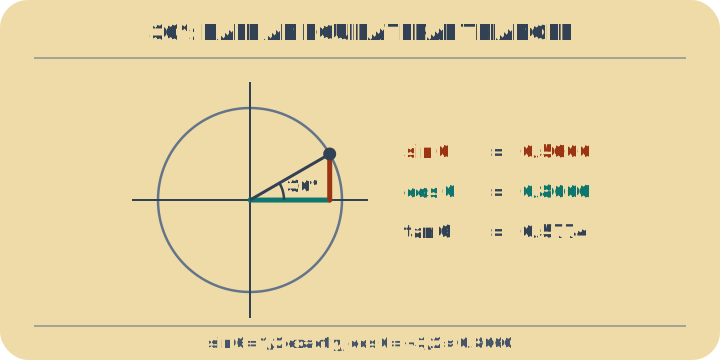
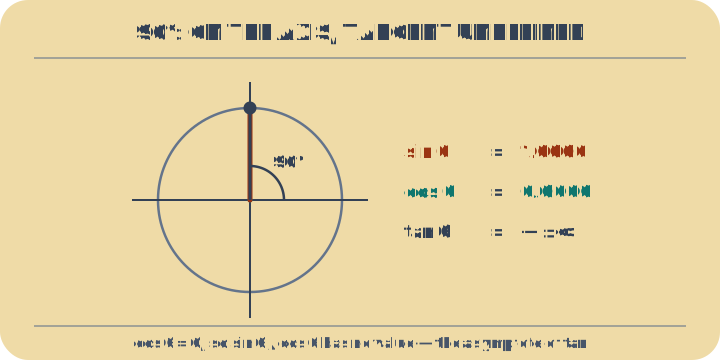
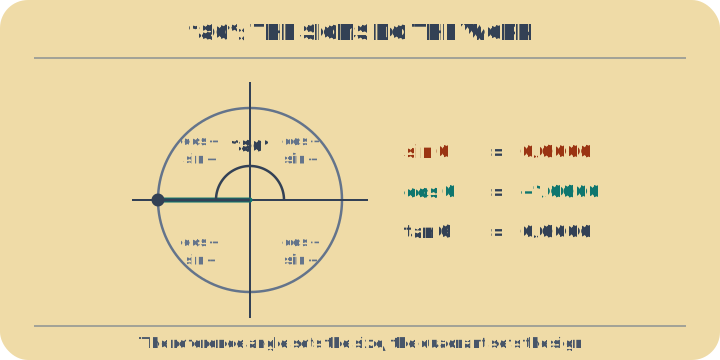
The unit circle is simply a circle of radius 1 centred on the origin. Pick any angle θ, and the point where it meets the circle has coordinates exactly (cos θ, sin θ) — because the radius is 1, no scaling is ever needed. The Pythagorean identity cos²θ + sin²θ = 1 is then just the distance formula in disguise: every point sits precisely one unit from the centre.
The word sine means bosom 🖖
The name sine is the fossil of a mistranslation. Indian mathematicians called the half-chord ardha-jyā; Arabic scholars transliterated it as jiba, written without vowels as jb. Later readers mistook it for jaib, meaning bosom, fold, or bay — so the Latin translators chose sinus, "a fold of a garment." Every time you write sin θ, you invoke a centuries-old clerical slip.
Example problems
- 0° - θ=0° → sin=0, cos=1, tan=0
- 30° - θ=30° → sin=0.5, cos=√3/2≈0.866, tan=1/√3≈0.577
- 45° - θ=45° → sin=cos=√2/2≈0.707, tan=1
- 60° - θ=60° → sin=√3/2≈0.866, cos=0.5, tan=√3≈1.732
- 90° - θ=90° → sin=1, cos=0, tan undefined
- 180° - θ=180° → sin=0, cos=-1, tan=0
- 270° - θ=270° → sin=-1, cos=0, tan undefined