Unit Circle Explorer

sin, cos & tan - visualized on the unit circle

Loading interactive simulation...

Tangent is named after a real line 🖖

Draw the vertical line x = 1. It grazes the circle at a single point, which is what makes it a tangent line. Now extend the radius at angle θ until it reaches that line: it arrives at height exactly tan θ. At 60° the radius passes through (0.5000, 0.8660) and stretches to (1, 1.7321) — the same 1.7321 this tool prints for tan 60°. That segment is the thing the function was named for, and it also explains the blow-up: as θ approaches 90° the radius turns parallel to the line and never meets it, which is why the readout gives +∞ rather than a number.

Where the coordinates are the answer 🖖

The unit circle is simply a circle of radius 1 centred on the origin. Pick any angle θ, and the point where it meets the circle has coordinates exactly (cos θ, sin θ) — because the radius is 1, no scaling is ever needed. The Pythagorean identity cos²θ + sin²θ = 1 is then just the distance formula in disguise: every point sits precisely one unit from the centre.

The word sine means bosom 🖖

The name sine is the fossil of a mistranslation. Indian mathematicians called the half-chord ardha-jyā; Arabic scholars transliterated it as jiba, written without vowels as jb. Later readers mistook it for jaib, meaning bosom, fold, or bay — so the Latin translators chose sinus, "a fold of a garment." Every time you write sin θ, you invoke a centuries-old clerical slip.

THE UNIT CIRCLE — WHICH ANGLE FAMILY, AND WHAT FIXES THE SIGNS?

Which Unit-Circle Case Are You In?

One circle of radius 1 carries all of trigonometry: the point at angle θ has coordinates (cos θ, sin θ), and that is the definition rather than a consequence of it. Almost every angle you will be asked about falls into one of three families — the 45° diagonal, the 30–60 pair cut from an equilateral triangle, and the four quadrantal angles sitting on the axes. Everything outside the first quadrant is one of those with a sign attached.

45° — the isosceles case, where sine and cosine are equal sinθ = cosθ = √2/2
30° and 60° — two readings of the same triangle sinθ = cos(90° − θ)
On an axis — one coordinate is zero and the tangent breaks cosθ = 0 ⇒ tanθ → ±∞
Past the first quarter — the sizes repeat, only the signs change ±f(θ′), θ′ = θ − 180°

01

45° — the isosceles case, where sine and cosine are equal

What you know: Half of a right angle. The point sits on the diagonal y = x, so both coordinates have to be the same and tan θ = 1.

Values: sinθ = cosθ = √2/2

Worked example: θ = 45° → sin θ = cos θ = √2/2 ≈ 0.7071, tan θ = 1

Open this case: 45°
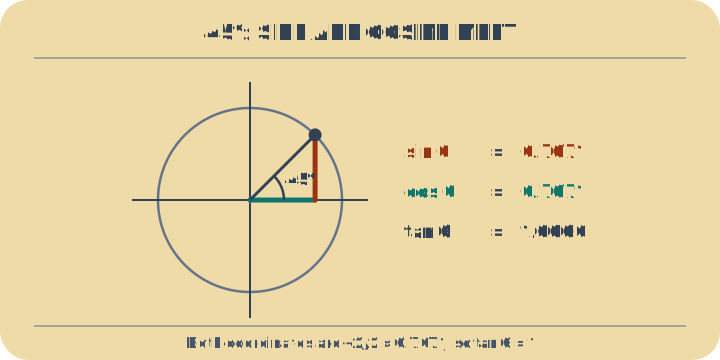
45° — the isosceles case, where sine and cosine are equal. The 45° point sits exactly on the diagonal, so both coordinates equal √2/2. Half of a right angle. The point sits on the diagonal y = x, so both coordinates have to be the same and tan θ = 1.
The 45° point sits exactly on the diagonal, so both coordinates equal √2/2.

02

30° and 60° — two readings of the same triangle

What you know: Half an equilateral triangle has sides 1, 1/2 and √3/2. Which length is the sine and which the cosine depends only on which acute angle you stand at.

Values: sinθ = cos(90° − θ)

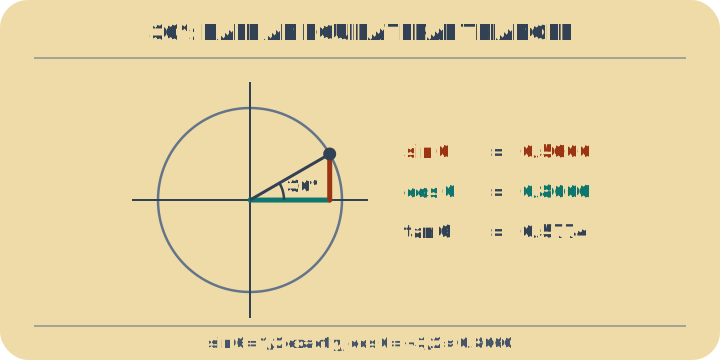
Worked example: θ = 30° → sin θ = 1/2 = 0.5, cos θ = √3/2 ≈ 0.8660, tan θ = 1/√3 ≈ 0.5774. At 60° the first two swap places.

Open this case: 30°
30° and 60° — two readings of the same triangle. The 30° point is low and far to the right; at 60° the same two lengths trade places. Half an equilateral triangle has sides 1, 1/2 and √3/2. Which length is the sine and which the cosine depends only on which acute angle you stand at.
The 30° point is low and far to the right; at 60° the same two lengths trade places.

03

On an axis — one coordinate is zero and the tangent breaks

What you know: The quadrantal angles 0°, 90°, 180° and 270° put the point on an axis, so one of the two coordinates is exactly zero.

Values: cosθ = 0 ⇒ tanθ → ±∞

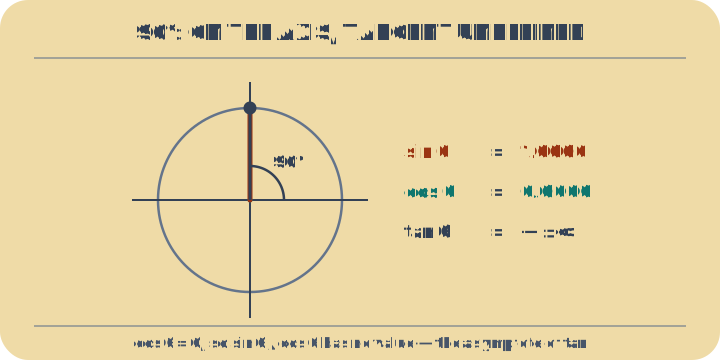
Worked example: θ = 90° → sin θ = 1, cos θ = 0, and tan θ = sin θ / cos θ has no value at all

Open this case: 90°
On an axis — one coordinate is zero and the tangent breaks. At 90° the point is at the top of the circle: height 1, width 0, and no tangent. The quadrantal angles 0°, 90°, 180° and 270° put the point on an axis, so one of the two coordinates is exactly zero.
At 90° the point is at the top of the circle: height 1, width 0, and no tangent.

04

Past the first quarter — the sizes repeat, only the signs change

What you know: Beyond 90° the coordinates keep the sizes they had at the reference angle back to the horizontal axis. The quadrant decides which of them are negative.

Values: ±f(θ′), θ′ = θ − 180°

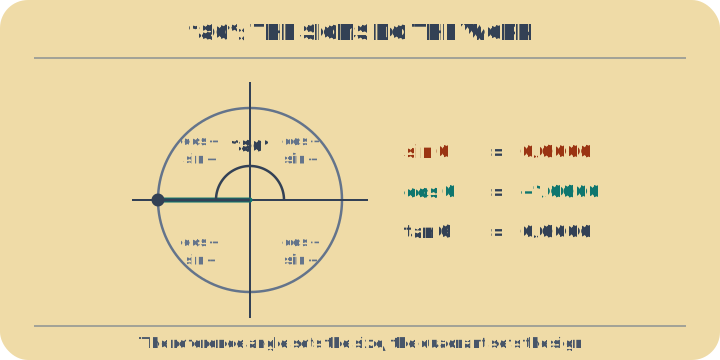
Worked example: θ = 180° → sin θ = 0, cos θ = −1. And sin 210° = −sin 30° = −0.5, because 210° has reference angle 30° and lies in the third quadrant.

Open this case: 180°
Past the first quarter — the sizes repeat, only the signs change. Half a turn puts the point at (−1, 0); the signs each quadrant gives are marked around the circle. Beyond 90° the coordinates keep the sizes they had at the reference angle back to the horizontal axis. The quadrant decides which of them are negative.
Half a turn puts the point at (−1, 0); the signs each quadrant gives are marked around the circle.

Problem solved in full

  1. A floor under π using nothing but the sine printed at 45° 5 steps

    Put a floor under π using nothing but the sine printed at 45°. This is the default state, θ = 45°, the isosceles case where sine and cosine are equal.

    1. 45° bisects the first quadrant, so the point lands on the line y = x and the two coordinates cannot differ. The circle equation is then left with one unknown.

    2. The identity row is that circle equation rearranged, and 45° is the only angle in the first quadrant that splits it into two equal halves. It is also the only one where the tangent, a ratio of two equal numbers, is exactly 1.

    3. A regular octagon inscribed in the circle is eight identical triangles meeting at the centre, each with two sides of length 1 and a 45° angle between them. The area of such a triangle is ½ab sin C, so the sine already on the screen is the only quantity the octagon needs.

    4. The unit circle has area π, so the ratio of the two areas says how much of the circle the octagon captures. Eight sides leaves a tenth of it outside.

    5. Doubling the number of sides needs the sine of half the angle, and the half-angle formula gets that from the cosine already printed. The same ½ab sin C then handles the sixteen-sided figure.

    Answer

    The tool prints sin 45° = cos 45° = 0.7071, tan 45° = 1.0000 and the identity as 0.5000 + 0.5000 = 1. Those four decimals carry the octagon to 2.8284 and, after one halving of the angle, the 16-gon to 3.0615. Both are floors rather than estimates: a polygon drawn inside the circle cannot enclose more area than the circle does. Keep doubling and the shortfall shrinks by a factor of about 4 each time — 9.97%, 2.55%, 0.64%, 0.16% — so a 96-sided polygon — the count Archimedes himself worked to — gives 3.1394 by this area method, correct to two decimal places and no further. That factor of 4 is why the method was eventually abandoned: each extra correct digit costs roughly two more doublings, and every doubling is another square root taken by hand.

Learning path

The triangle rules, and where they come from

Leads to Coordinate geometry sine, cosine and tangent for every angle — including the angle where tangent has no value at all.

References (3)

Example problems

  • - The radius lies flat along the x-axis, so its endpoint is (1, 0) and cos is 1 for the plain reason that the x-coordinate IS the cosine. Tangent is zero here because the radius meets the line x = 1 at the axis itself.
  • 30° - Half an equilateral triangle, which is why this is the one value everybody is made to memorise: cut a unit equilateral triangle down the middle and the short side is exactly a half. Sin 30° is 0.5 with no approximation anywhere in it.
  • 45° - The only angle where sin and cos are equal, because the triangle is isosceles and the point sits on the line y = x. Tangent is exactly 1, so the extended radius meets the tangent line at the same height as the circle itself.
  • 60° - The same half-equilateral as 30°, read the other way up. Every value swaps: what was the cosine is now the sine. Tangent reaches √3, so the radius has to travel well past the circle before it meets the line x = 1.
  • 90° - The radius points straight up and never meets the line x = 1 at all, which is what the undefined tangent means geometrically rather than arithmetically. Approach 90° from below and the readout climbs without limit; it does not fail at the last step.
  • 180° - Half a turn puts the point at (−1, 0), so the cosine is negative for the first time while the sine is back to zero. Tangent is zero again, and the two angles that give tan = 0 sit at opposite ends of the circle.
  • 270° - Three quarters round, at (0, −1), where the sine reaches its minimum. The radius points straight down and is parallel to the line x = 1 again, so this is the second place tangent has no value — the two undefined angles sit exactly half a turn apart, which is the period of the tangent rather than of the circle.