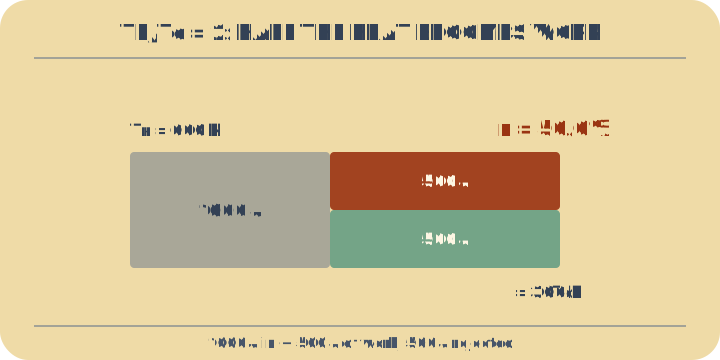
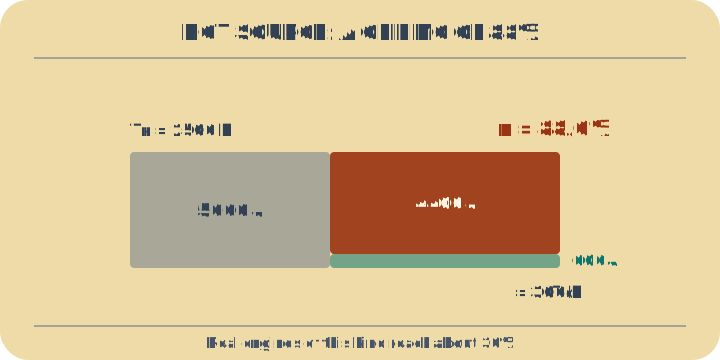
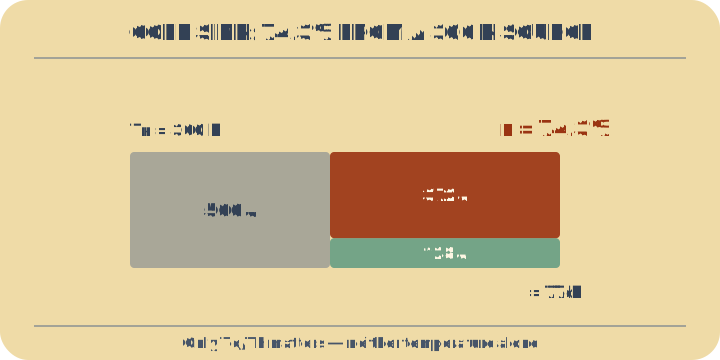
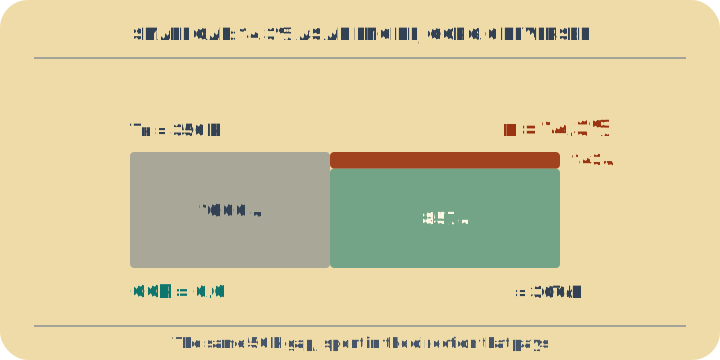
A heat engine takes heat from something hot, converts part of it to work, and dumps the rest somewhere cold. The Carnot efficiency is the largest share any engine can convert, and it is fixed by the two temperatures alone: η = 1 − T_C/T_H. Not the fuel, not the working substance, not the engineering — the temperatures.
What each symbol means
T_H, T_C- the hot and cold reservoir temperatures, in kelvin. Absolute temperatures: the formula is a ratio, so a scale with an arbitrary zero gives an arbitrary answer.
Q_H- the heat drawn from the hot reservoir in one cycle.
Q_C- the heat dumped into the cold one. It is what makes an engine an engine — you cannot set it to zero.
ηW/Q_H, the fraction of the heat taken in that leaves as work.
Where the formula comes from
- Start with bookkeeping. Over a complete cycle the engine returns to its starting state, so it stores nothing: everything in must come out.
W = Q_H − Q_C, and therefore η = W/Q_H = 1 − Q_C/Q_H. Efficiency is now entirely a question of the ratio Q_C/Q_H.
- Notice what has NOT been ruled out. Conservation alone is happy with
Q_C = 0 and η = 1 — an engine that turns all its heat into work. Nothing in the first law forbids it. The limit has to come from somewhere else.
- It comes from entropy. Taking
Q_H out of the hot reservoir lowers its entropy by Q_H/T_H; dumping Q_C into the cold one raises its entropy by Q_C/T_C. The engine itself returns to its starting state, so the total change is just those two. The second law forbids a decrease, so Q_C/T_C ≥ Q_H/T_H.
- Rearranged,
Q_C/Q_H ≥ T_C/T_H, and substituting into step 1 gives η ≤ 1 − T_C/T_H. Equality needs the total entropy change to be exactly zero, which means a perfectly reversible cycle. So the Carnot value is not a clever design — it is the ceiling every design is measured against, and every real irreversibility raises Q_C and lowers η.
How to read what you see
The left panel is the cycle on pressure-volume axes: two isotherms at T_H and T_C joined by two adiabats, and the area enclosed is the work per cycle. The right panel is the same thing as a flow — Q_H in from the hot block, W out to the side, Q_C down into the cold block — with the three numbers on their arrows. Change only Q_H and the loop keeps its shape while every energy scales; change a temperature and the loop itself changes proportions.
- Assumes
- Two reservoirs so large that drawing heat does not cool one or warm the other, and a cycle run reversibly — slowly enough that the working substance is in equilibrium at every instant. Both temperatures in kelvin. The reservoirs are also assumed to be the only things the engine touches: no friction, no heat leaking around the cycle rather than through it.
- Breaks when
- The ΔS row is zero for every input you can type, and that is a property of the arithmetic rather than a verdict on the engine.
Q_C is computed here as Q_H − W with W from the Carnot formula, which makes Q_C/T_C and Q_H/T_H equal identically — the row confirms that the Carnot cycle is the reversible one, and cannot detect anything else. A real engine generates entropy, and the honest way to see that here is to compare a measured efficiency against the ceiling this page prints, not to look for a non-zero ΔS.