Doppler Effect Simulator

See how relative motion between source and observer changes the perceived frequency.

Loading interactive simulation...

Wavefront compression and frequency translation 🖖

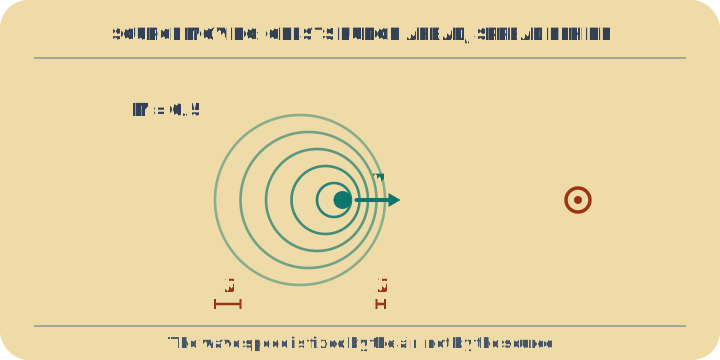
The Doppler effect describes the shift in frequency of a wave when the source and observer are in relative motion. As the source approaches, successive wavefronts are compressed, shortening the wavelength and increasing the observed frequency: f' = f * (v + v_o) / (v - v_s). This translates acoustic waves to higher pitches or electromagnetic waves to shorter wavelengths (blue-shift), and vice versa as they depart.

Why the siren drops as it passes 🖖

A common surprise: an ambulance approaching at a steady speed does not rise in pitch โ€” it holds one high, constant tone, then snaps to a lower constant tone the instant it passes you. The pitch changes only because the direction of motion relative to you flips from "toward" to "away". Set the source speed and press play: the front-observer readout stays fixed while approaching, then jumps down at the moment of passing.

Sound's Doppler betrays who is really moving 🖖

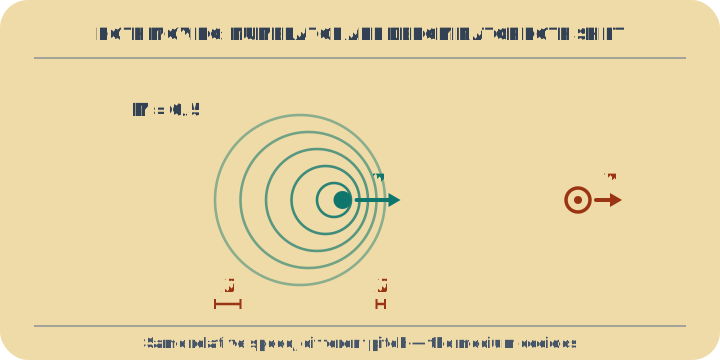
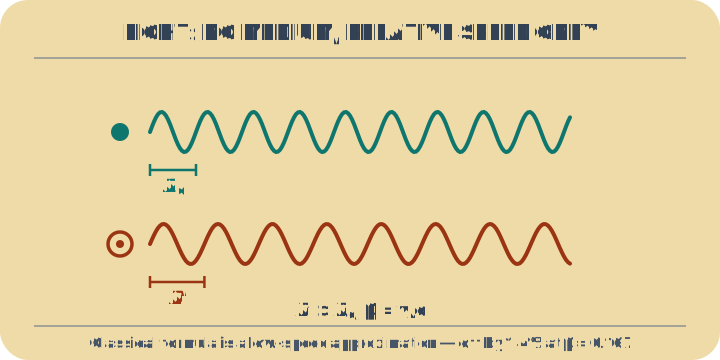
For sound, moving the source and moving the observer are not equivalent, even at an identical closing speed. A source approaching a still listener at 34.3 m/s raises 440 Hz to fยท343/308.7 โ‰ˆ 489 Hz; a listener approaching a still source at the same 34.3 m/s hears only fยท377.3/343 โ‰ˆ 484 Hz. The air is a preferred frame, so sound's Doppler shift secretly reveals who moves relative to the medium โ€” something light's Doppler effect, with no medium, can never do.

Example problems

  • Ambulance - Ambulance siren at 30 m/s
  • Train - Train horn with moving observer
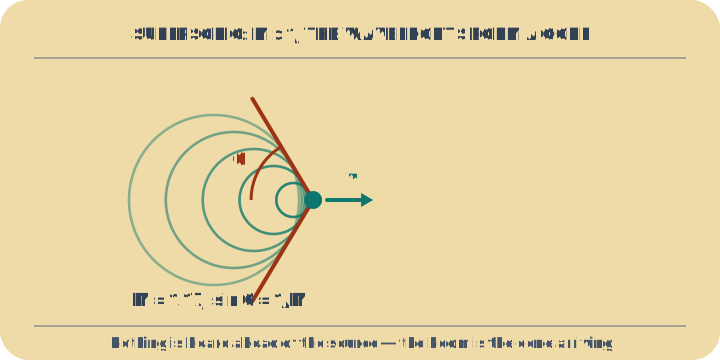
  • Supersonic - Supersonic: Mach > 1, shock cone
  • Redshift - Cosmological redshift analogy