Ideal Gas Law Calculator

Explore the ideal gas law. Lock one variable and solve for it from the other three.

Loading interactive simulation...

Statistical thermodynamics and the ideal equation 🖖

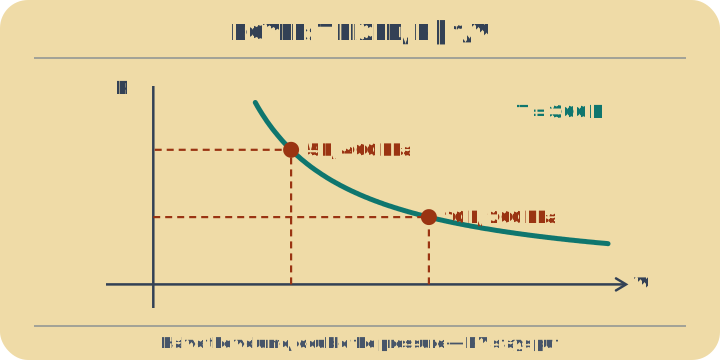
The ideal gas law, PV = nRT, describes the state of a theoretical gas of point-like particles undergoing elastic collisions with no intermolecular forces. Statically, this equation unifies Boyle's law, Charles's law, and Avogadro's law. In statistical mechanics, it is derived from the kinetic theory of gases, where pressure is the average momentum transferred to container walls by colliding particles.

One equation, four knobs, one universal constant 🖖

The tool locks three of the quantities P, V, n, T and lets you drag the fourth; PV = nRT then forces the rest to respond. The constant R is the same for every gas, so helium and carbon dioxide obey identical arithmetic — a given amount fills the same volume at equal temperature and pressure, whatever the molecule. That is the quiet power of the ideal model: the chemistry disappears, and only the number of particles counts.

Every gas line points to −273.15 °C 🖖

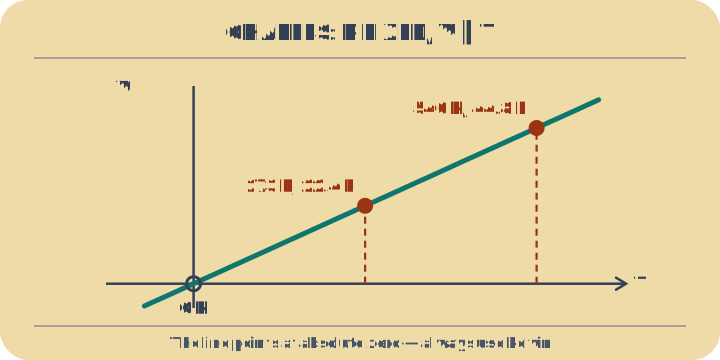
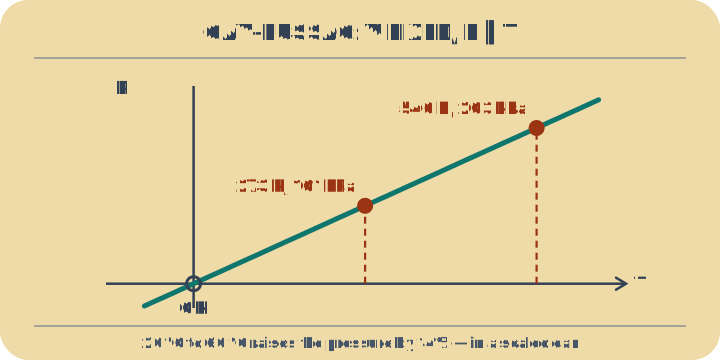
Plot volume against temperature at fixed pressure and extend the line backwards: for every gas it crosses zero volume at exactly −273.15 °C. No one has ever cooled a gas that far — the number comes purely from extrapolating a ruler-straight line, a trick Guillaume Amontons noticed around 1700. That vanishing point is the zero of the Kelvin scale, which is why the T in PV = nRT must always be measured in kelvin, never in degrees Celsius.

Example problems