Kinematics (SUVAT) Calculator

solve the equations of motion — enter any 3, find the other 2

Loading interactive simulation...

why 5 letters, only 2 equations? 🖖

The five SUVAT letters look like five independent facts, but they aren't. Every SUVAT equation is just v=u+at and s=ut+½at² rearranged — the other three (s=(u+v)/2·t, v²=u²+2as, s=vt-½at²) fall straight out of substituting one into the other. That's why any 3 knowns pin down the other 2: you're really only ever solving 2 equations in 2 unknowns.

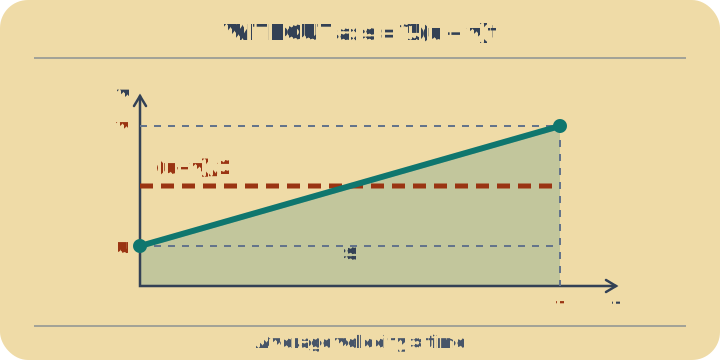
Displacement is just the area on the graph 🖖

The velocity–time graph this tool draws is a straight line, because acceleration stays constant. The shaded region under that line is the displacement s, and since the region is a trapezoid its area equals the average velocity, (u+v)/2, times the time. Takeaway: with steady acceleration you can read distance straight off the graph as an area — no formula-juggling required.

Galileo's odd-number rule 🖖

Long before calculus, Galileo noticed that an object accelerating from rest covers distances in the ratio 1 : 3 : 5 : 7 across equal time intervals — always the odd numbers. Add them up and the totals are 1, 4, 9, 16, i.e. the squares, which is exactly why s = ½at². He deduced this in the 1600s by rolling balls down ramps, decades before Newton wrote it as an equation.

KINEMATICS THEORY — THE FIVE EQUATIONS OF MOTION

Choosing a SUVAT Equation: Which Letter Is Missing?

Constant acceleration ties five quantities together — displacement s, initial velocity u, final velocity v, acceleration a and time t. Every problem hands you three of them and asks for a fourth. Each equation below leaves exactly one letter out, so the one you want is the one that omits the quantity you neither know nor need.

Without s — uses v, u, a, t v = u + at
Without v — uses s, u, a, t s = ut + ½at2
Without a — uses s, u, v, t s = ½(u + v)t
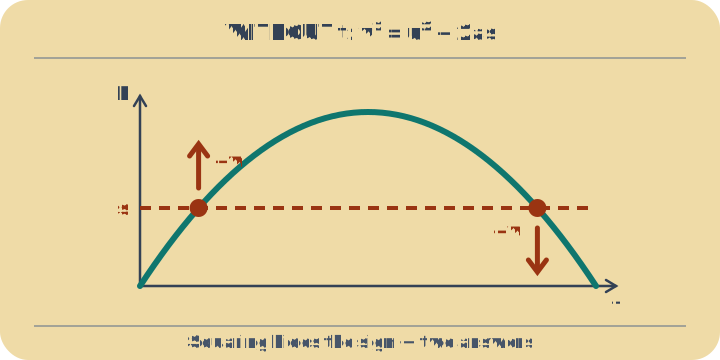
Without t — uses s, u, v, a v2 = u2 + 2as
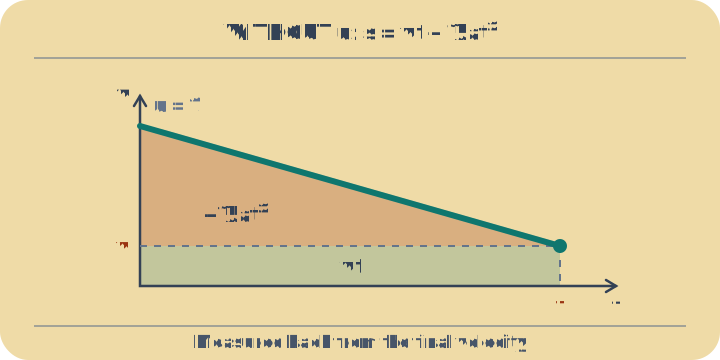
Without u — uses s, v, a, t s = vt − ½at2

01

Without s — uses v, u, a, t

What you know: Three of initial velocity u, final velocity v, acceleration a and time t. Displacement never appears.

Equation: v = u + at

Worked example: u = 25 m/s, v = 0, t = 5 s → a = (0 − 25) / 5 = −5 m/s²

Open this case: braking to a stop
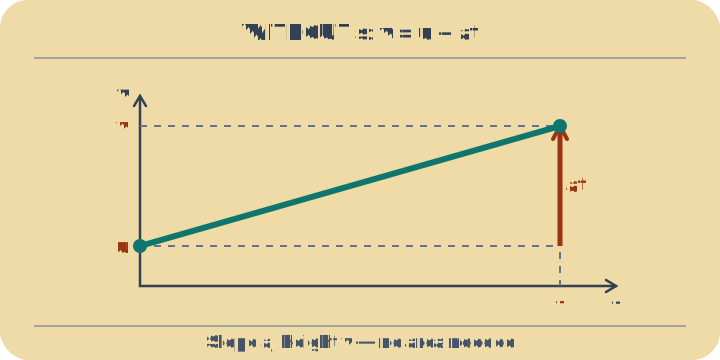
Without s — uses v, u, a, t. Velocity–time graph: v is the height of the line after time t. Displacement plays no part. Three of initial velocity u, final velocity v, acceleration a and time t. Displacement never appears.
Velocity–time graph: v is the height of the line after time t. Displacement plays no part.

02

Without v — uses s, u, a, t

What you know: Initial velocity u, acceleration a and time t. You want the distance covered, not the speed at the end.

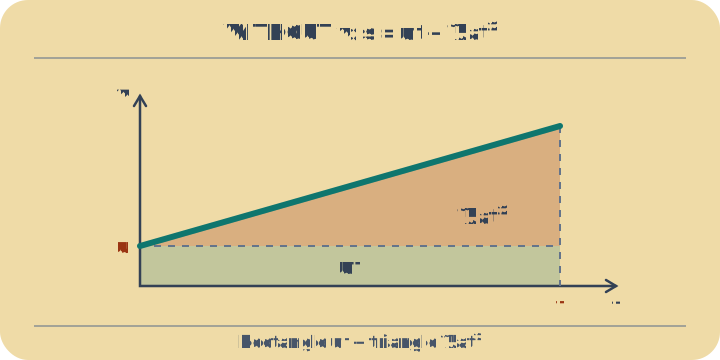
Equation: s = ut + ½at2

Worked example: u = 0, a = 9.81 m/s², t = 3 s → s = 0 + ½ · 9.81 · 3² = 44.1 m

Open this case: dropped from rest
Without v — uses s, u, a, t. Area under the line splits into a rectangle ut plus a triangle ½at². Initial velocity u, acceleration a and time t. You want the distance covered, not the speed at the end.
Area under the line splits into a rectangle ut plus a triangle ½at².

03

Without a — uses s, u, v, t

What you know: Starting speed u, final speed v and time t. The acceleration is unknown, or simply beside the point.

Equation: s = ½(u + v)t

Worked example: u = v = 12 m/s, t = 6 s → s = ½(12 + 12) · 6 = 72 m

Open this case: constant velocity
Without a — uses s, u, v, t. Trapezium area: the mean of u and v, multiplied by t. Starting speed u, final speed v and time t. The acceleration is unknown, or simply beside the point.
Trapezium area: the mean of u and v, multiplied by t.

04

Without t — uses s, u, v, a

What you know: Displacement s, one of the two velocities, and the acceleration. The clock is never started.

Equation: v2 = u2 + 2as

Worked example: s = 5 m, u = 15 m/s, a = −9.81 m/s² → v² = 225 − 98.1, so v = ±11.3 m/s

Open this case: ball passes twice
Without t — uses s, u, v, a. Same height, two velocities: the ± is the way up and the way down. Displacement s, one of the two velocities, and the acceleration. The clock is never started.
Same height, two velocities: the ± is the way up and the way down.

05

Without u — uses s, v, a, t

What you know: Final velocity v, acceleration a and time t. The starting speed is unknown and you do not need it.

Equation: s = vt − ½at2

Worked example: v = 0, a = −3 m/s², t = 25 s → s = 0 − ½(−3)(25²) = 937.5 m

Open this case: runway rollout
Without u — uses s, v, a, t. Working back from the end: vt minus the slice the deceleration removed. Final velocity v, acceleration a and time t. The starting speed is unknown and you do not need it.
Working back from the end: vt minus the slice the deceleration removed.
References (1)
  • Insight block 3 — the odd-number rule, and the ramps it came from: G. Galilei, Discorsi e dimostrazioni matematiche intorno a due nuove scienze. Leiden, 1638, Third Day — distances in the ratio 1 : 3 : 5 : 7 over equal times, which sum to the squares.

Problem solved in full

  1. A car starting at 5 m/s and accelerating at 2 m/s² 5 steps

    A car starts at 5 m/s and accelerates at 2 m/s² for 4 seconds. Find how fast and how far — then find when it passes the halfway point, which is not at the halfway time.

    1. Velocity first, because it is the definition of acceleration rearranged: the speed gained is the rate times the duration.

    2. Displacement is the starting speed carried for four seconds, plus what the acceleration adds. The two terms are 20 m and 16 m, and neither dominates yet.

    3. Now check with the equation that has no time in it. It returns 169 on both sides, which is not a new fact — it is the first two equations with t eliminated, so agreement is guaranteed and disagreement would mean arithmetic error.

    4. The average velocity is the mean of the endpoints, and only because the acceleration is constant. Multiply by the time and the displacement comes out again.

    5. Now the halfway point. Half the distance is 18 m, and solving the quadratic puts it at 2.424 s — not 2 s. At t = 2 s the car has covered only 14 m of the 36.

    Answer

    The tool prints s = 36 m and v = 13 m/s. Step 5 is the one worth carrying: under acceleration, half the time and half the distance are different moments, and the second half of any accelerating journey is always the quicker one. This is why an overtake feels wrong when it is planned by distance — the gap you can see closes in the time you have left, not in the space. Step 3 is the other half of the lesson: there are five SUVAT equations and two independent facts, so a third equation can confirm your arithmetic and can never add information.

Learning path

Throwing things

Leads to Projectile motion the five quantities and the two independent equations that link them, valid on one condition: the acceleration does not change.

Example problems

  • accelerating car - u=5 m/s, a=2 m/s², t=4 s → v=13 m/s, s=36 m
  • braking to a stop - u=25 m/s, v=0, t=5 s → a=-5 m/s², s=62.5 m (braking to a stop)
  • ball passes twice - s=5 m, u=15 m/s, a=-9.81 m/s² → ball thrown up passes 5 m twice, on the way up and the way down
  • constant velocity - u=v=12 m/s, t=6 s → a=0, s=72 m (no acceleration)
  • dropped from rest - u=0, a=9.81 m/s², t=3 s → v=29.4 m/s, s=44.1 m (dropped from rest)
  • runway rollout - v=0, a=-3 m/s², t=25 s → s=937.5 m (touchdown speed u=75 m/s is never needed)