Kinematics (SUVAT) Calculator
solve the equations of motion — enter any 3, find the other 2
why 5 letters, only 2 equations? 🖖
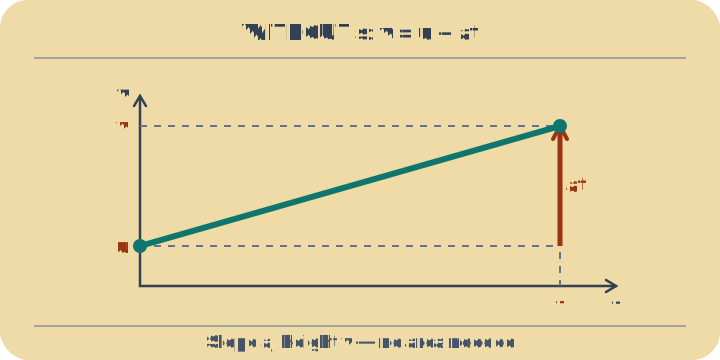
The five SUVAT letters look like five independent facts, but they aren't. Every SUVAT equation is just v=u+at and s=ut+½at² rearranged — the other three (s=(u+v)/2·t, v²=u²+2as, s=vt-½at²) fall straight out of substituting one into the other. That's why any 3 knowns pin down the other 2: you're really only ever solving 2 equations in 2 unknowns.
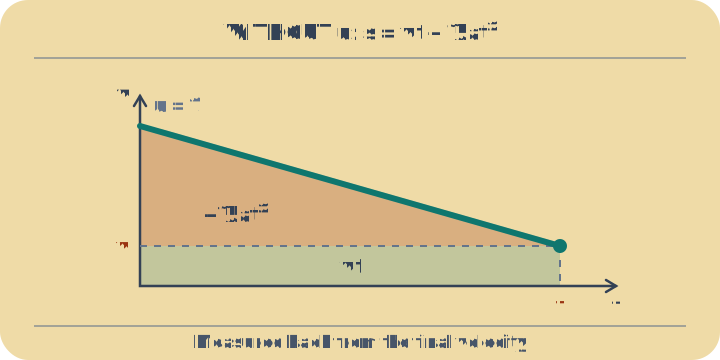
Displacement is just the area on the graph 🖖
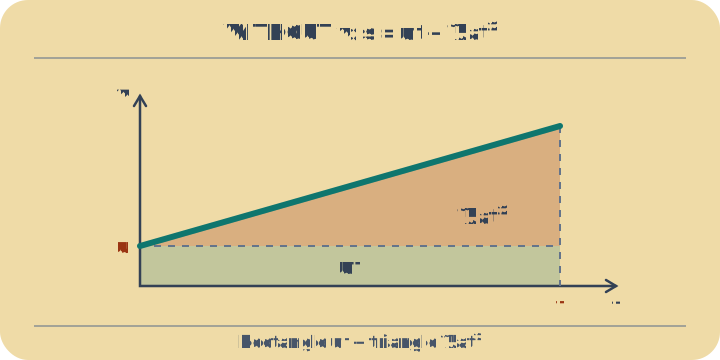
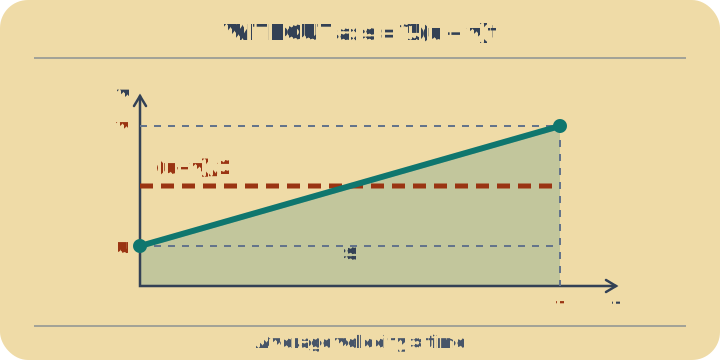
The velocity–time graph this tool draws is a straight line, because acceleration stays constant. The shaded region under that line is the displacement s, and since the region is a trapezoid its area equals the average velocity, (u+v)/2, times the time. Takeaway: with steady acceleration you can read distance straight off the graph as an area — no formula-juggling required.
Galileo's odd-number rule 🖖
Long before calculus, Galileo noticed that an object accelerating from rest covers distances in the ratio 1 : 3 : 5 : 7 across equal time intervals — always the odd numbers. Add them up and the totals are 1, 4, 9, 16, i.e. the squares, which is exactly why s = ½at². He deduced this in the 1600s by rolling balls down ramps, decades before Newton wrote it as an equation.
Example problems
- accelerating car - u=5 m/s, a=2 m/s², t=4 s → v=13 m/s, s=36 m
- braking to a stop - u=25 m/s, v=0, t=5 s → a=-5 m/s², s=62.5 m (braking to a stop)
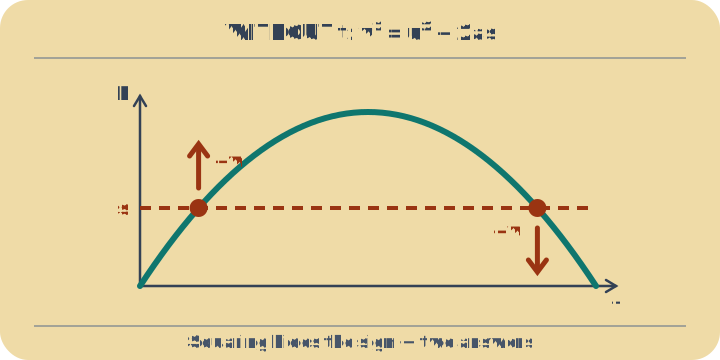
- ball passes twice - s=5 m, u=15 m/s, a=-9.81 m/s² → ball thrown up passes 5 m twice, on the way up and the way down
- constant velocity - u=v=12 m/s, t=6 s → a=0, s=72 m (no acceleration)
- dropped from rest - u=0, a=9.81 m/s², t=3 s → v=29.4 m/s, s=44.1 m (dropped from rest)