Lens and Imaging Studio

Explore sign conventions, magnification, and image orientation by moving distance and focal length.

Loading interactive simulation...

Gaussian Optics Limits 🖖

The paraxial approximation breaks down at high curvature...

One focal point decides everything 🖖

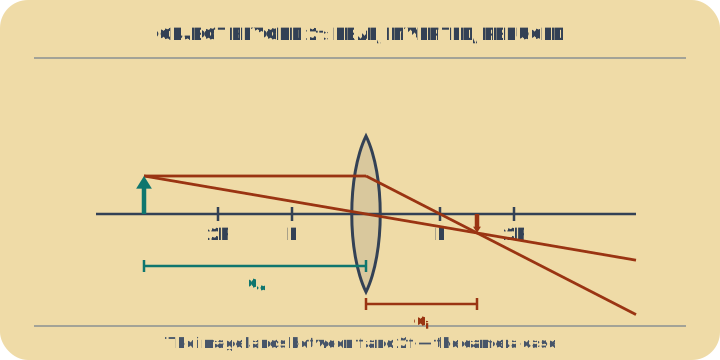
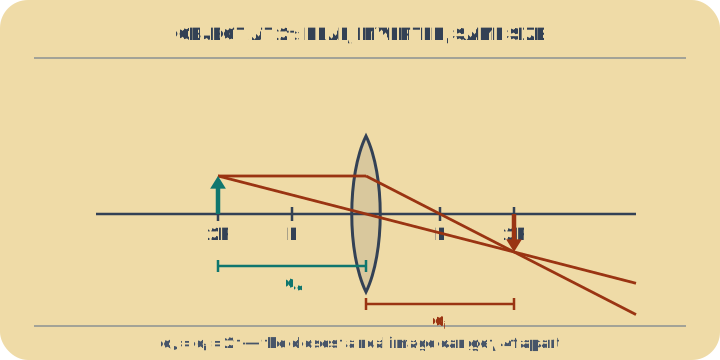
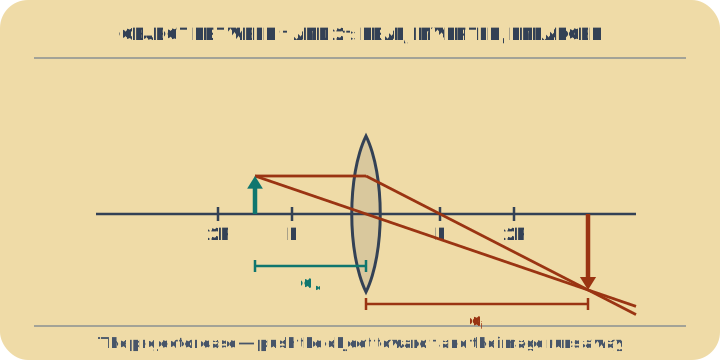
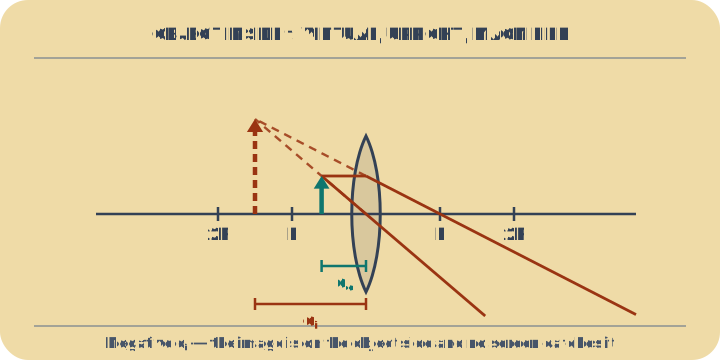
This tool rests on a single relationship — the thin-lens equation 1/f = 1/do + 1/di — yet the whole behaviour hinges on one thing: where the object sits relative to the focal point F. Place it beyond F and a converging lens throws a real, inverted image you could catch on a screen, exactly as a camera or projector does. Slide it inside F and the same lens gives a virtual, upright, magnified image — precisely how a magnifying glass works.

A glass lens nearly quits underwater 🖖

A lens bends light only because of the refractive-index contrast at its surfaces, so its power depends on the surrounding medium, not the glass alone. Move a typical n = 1.5 lens from air into water (n = 1.33) and the lensmaker's equation shows its power dropping to about a quarter — the focal length you set here would nearly quadruple. The same effect cripples the eye's cornea underwater, which is why a diving mask (restoring an air gap) brings the world back into focus.

Example problems

  • Object beyond 2f - Object beyond 2f forms a real inverted reduced image between f and 2f.
  • Object at 2f - Object at 2f forms a real inverted same-size image at 2f.
  • Object inside f - Object inside focal length forms a virtual upright magnified image.
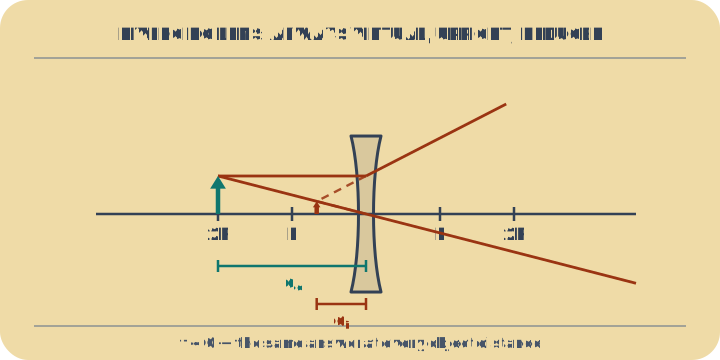
  • Concave lens - Concave lens always forms a virtual upright reduced image.