Momentum & Collision Lab
Simulate 1D cart collisions to explore conservation of momentum, kinetic energy changes, and the coefficient of restitution.
Spock Level Insight 🖖
In any closed system, momentum is always conserved because of Newton's third law: the force Cart 1 exerts on Cart 2 is equal and opposite to the force Cart 2 exerts on Cart 1. Kinetic energy, however, is only conserved in perfectly elastic collisions (e = 1). In real-world macroscopic collisions, energy is always dissipated into thermal energy, sound, and material deformation (e < 1). On the subatomic scale, collisions between gas molecules are perfectly elastic, which is why gases don't eventually settle to the floor as cold puddles of static matter.
The one number that sets the bounce 🖖
The coefficient of restitution e is this tool's master dial. It is simply the separation speed divided by the approach speed: e = 1 is a perfect rebound (a superball), while e = 0 means the carts stick together like wet clay. You can measure it at home — drop a ball and divide bounce height by drop height, which equals e². A basketball that returns to about 64% of its drop height has e ≈ 0.8.
Voyager 2 played billiards with Jupiter 🖖
A spacecraft gravity assist obeys these exact rules with nothing ever touching. In the planet's reference frame the flyby is perfectly elastic (e = 1): the probe leaves at the same speed it arrived, merely redirected. But in the Sun's frame it can pick up almost twice the planet's orbital speed. Voyager 2 gained roughly 10 km/s at Jupiter this way — borrowed from the planet's orbital motion, which slowed by an utterly negligible amount in return.
Example problems
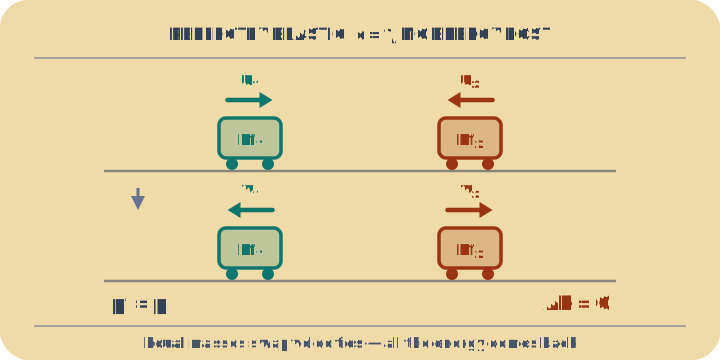
- Billiard balls bounce - Equal masses, e=1: velocities swap exactly (+3 → -3 and -3 → +3) — the classic elastic billiard-ball exchange.
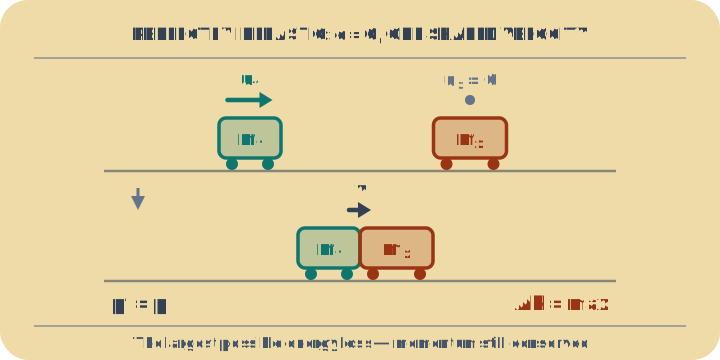
- Inelastic stick - m1=2 kg at 3 m/s strikes stationary m2=3 kg, e=0: they stick together and move off at 1.2 m/s.
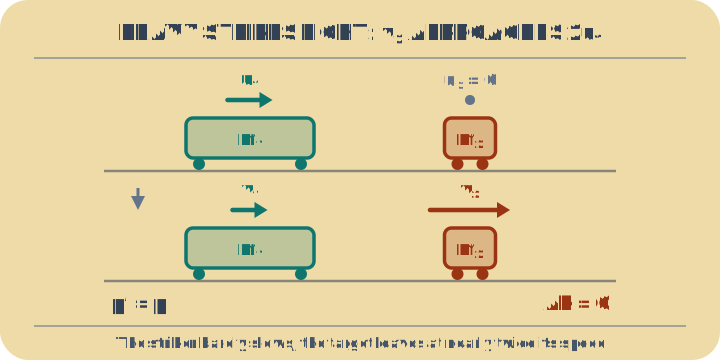
- Heavy hits light - m1=8 kg hits stationary m2=1 kg elastically: the heavy cart barely slows (3→2.33 m/s) while the light one shoots off at 5.33 m/s.
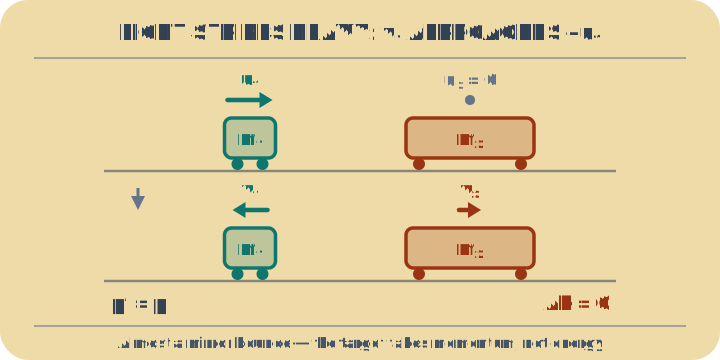
- Light hits heavy - m1=1 kg hits stationary m2=8 kg elastically: the light cart bounces straight back (3→-2.33 m/s) while the heavy one barely creeps forward (0→0.67 m/s).
- Real bumper bounce - e=0.5, m1=3 kg at 4 m/s meets m2=2 kg at -2 m/s: the partial bounce dissipates ~58% of the kinetic energy, a realistic bumper-car collision.