Newton's Second Law (F=ma) Simulator

push a block, watch F = ma play out — friction, an incline, and a full free-body diagram

Loading interactive simulation...

why weight and normal force aren't a 3rd-law pair 🖖

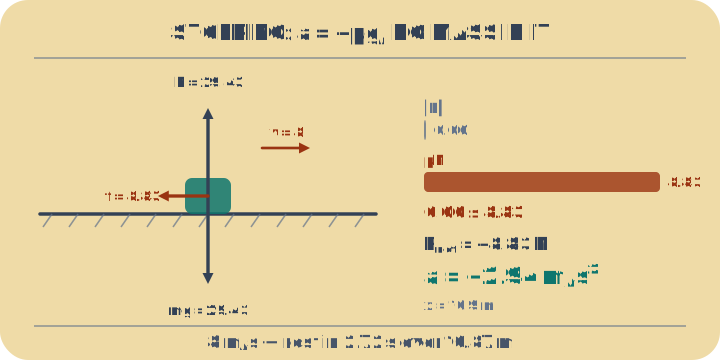
Weight (mg) and the normal force (N) are equal and opposite here, so it's tempting to call them a Newton's-third-law pair — but they aren't. A third-law pair must act on two *different* objects, and both of these act on the same block. The real pairs are: Earth pulls the block down / the block pulls Earth up (gravity, both directions), and the block pushes down on the surface / the surface pushes back up on the block — that second one is the N you see here. N only happens to equal mg because the block isn't accelerating vertically; tilt the surface or put the block in an accelerating elevator and N changes while mg doesn't. This exact mix-up is one of the most well-documented misconceptions in introductory mechanics.

Only the leftover force accelerates 🖖

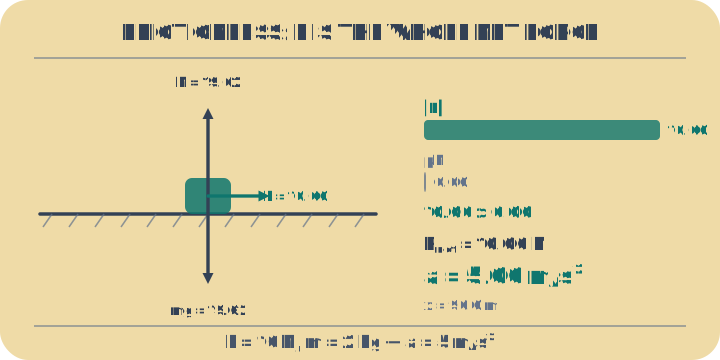
Newton's second law, F=ma, is really about the net force — everything else cancels out. When you push this block, part of your push can be eaten by friction; only what's left over drives the acceleration. That's why a 10 N push on a 2 kg block gives a = 5 m/s² with no friction, but less once friction takes its cut. Double the mass and the same net force gives half the acceleration.

Newton never actually wrote F=ma 🖖

The equation stamped on this tool isn't quite Newton's. In the Principia (1687) he stated the second law in words, in terms of momentum: the change in a body's quantity of motion is proportional to the impressed force. The tidy algebraic form F = ma came later — it's usually credited to Leonhard Euler around 1752. For constant mass the two agree, but it's the momentum version (F = dp/dt) that survives into relativity and rockets shedding fuel as they burn.

Example problems

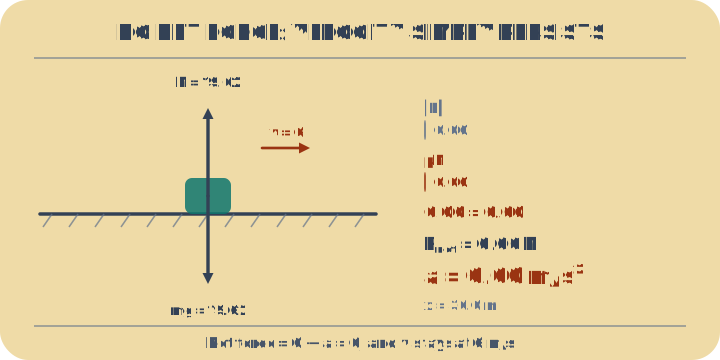
  • no net force - No net force on a moving block → constant velocity forever (Newton's 1st law)
  • frictionless push - m=2 kg, F=10 N, no friction → a=5 m/s² (clean 2nd law)
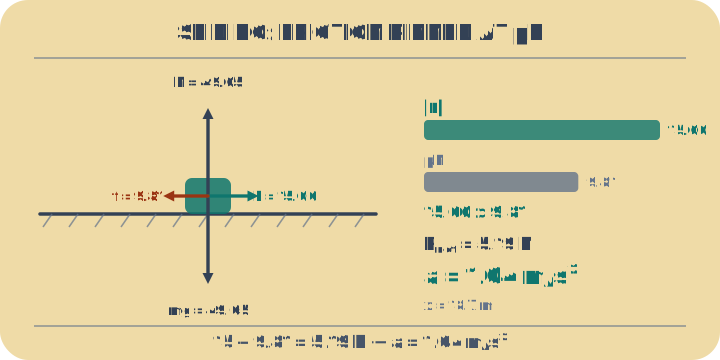
  • push with friction - m=5 kg, F=15 N, mu=0.2 → friction cuts the net force, a≈1.04 m/s²
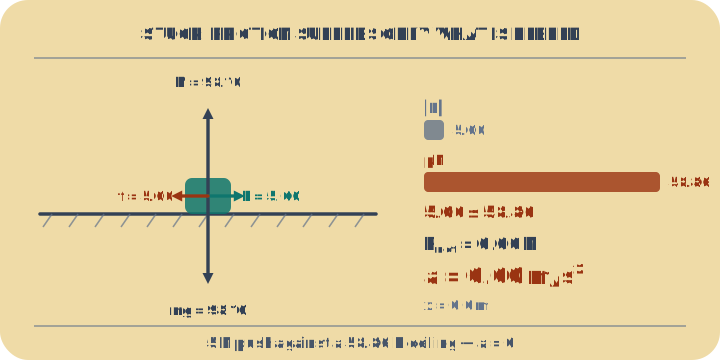
  • stuck by friction - Max static friction (58.9 N) beats the 5 N push → block stays put, a=0
  • sliding to a stop - Friction alone brings a moving block to rest in ~2.7 s, then it stays stopped
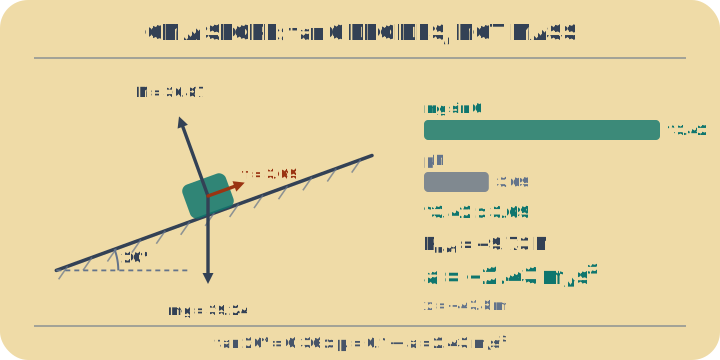
  • slides down a ramp - 20° incline: gravity (13.4 N) beats max static friction (3.7 N) → slides from rest