Projectile Motion Simulator

parabolic trajectory with live animation

Loading interactive simulation...

Classical kinematics and parabolic trajectories 🖖

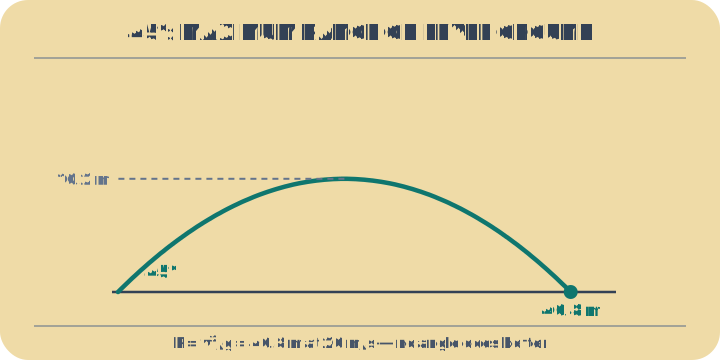
Projectile motion is the kinematic analysis of an object launched into a gravitational field, assuming constant acceleration g downwards. Neglecting air resistance, the horizontal velocity remains constant, while the vertical motion behaves as a uniformly accelerated system, producing a parabolic path. The maximum range is achieved at an angle of 45 degrees, where the horizontal and vertical velocity components are balanced.

Two motions stacked into one 🖖

A projectile is really doing two independent things at once: drifting sideways at a steady pace while falling under gravity. Neither influences the other, which leads to a famous result — a bullet fired horizontally and one simply dropped from the same height hit the ground at the exact same moment. Change the launch speed here and watch the sideways reach grow while the time in the air stays tied only to the vertical motion.

Above ground, 45° stops winning 🖖

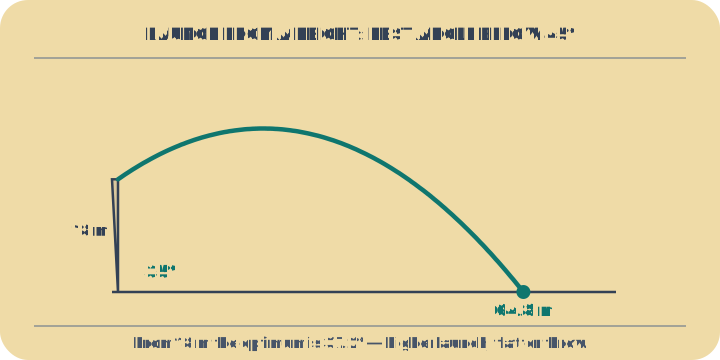
The famous 45° rule for maximum range only holds when you launch and land at the same height. Add a launch height h and the best angle drops below 45°, following θ = arctan(v / √(v² + 2gh)). Throw a ball off a cliff and aiming a little flatter than 45° actually sends it farther — raise the height slider and hunt for the true optimum.

Example problems

  • 45 deg max range - v=20 m/s, θ=45°, h=0 → range˜40.8 m (maximum for this speed)
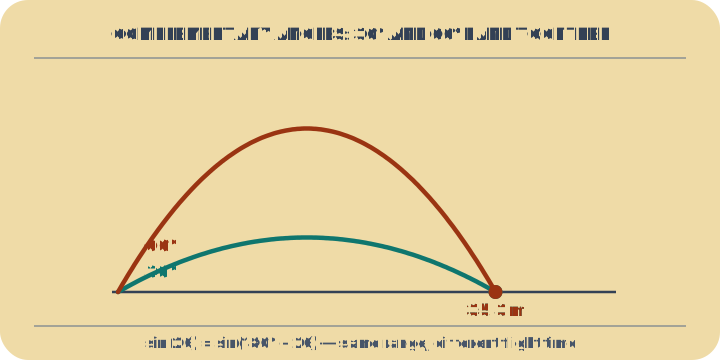
  • 30 deg - v=20 m/s, θ=30° → range˜35.3 m (same as 60° by symmetry)
  • 60 deg - v=20 m/s, θ=60° → range˜35.3 m (same as 30°)
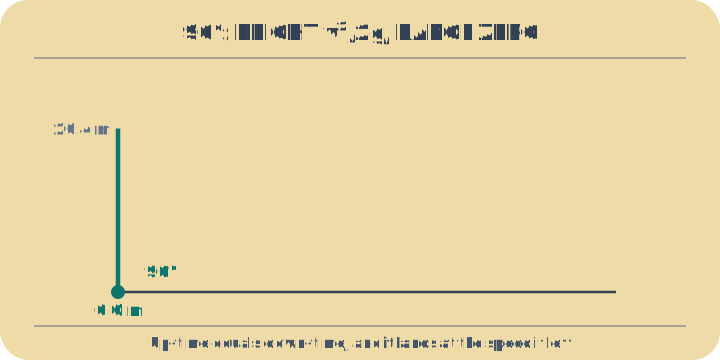
  • 90 deg straight up - v=20 m/s, θ=90° → straight up, range=0, max height˜20.4 m
  • low-angle shot - v=55 m/s, θ=12° → flat trajectory, range˜125 m
  • from a cliff - v=22 m/s, θ=35°, h=18 m → range˜65 m, flight˜3.6 s