RC Circuit Simulator
See how a resistor-capacitor circuit charges and discharges exponentially with time constant τ = RC.
The exponential mathematics of capacitor charge 🖖
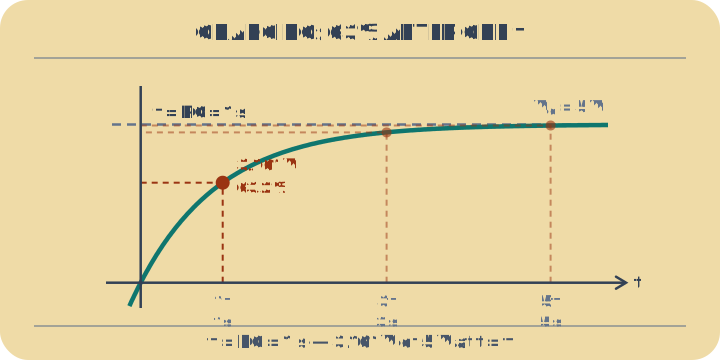
An RC circuit behaves dynamically because a capacitor stores energy in an electric field. The rate of charging or discharging is governed by the time constant, τ = RC. Statically, the voltage across a charging capacitor follows the exponential function V(t) = V₀(1 − e^{-t/RC}), which means it never truly reaches V₀ but asymptotically approaches it, crossing 63.2% at 1τ and 99.3% at 5τ. In frequency domain analysis, this exponential delay forms the basis of analog filtering: it acts as a low-pass filter when voltage is measured across the capacitor, attenuating high-frequency noise, or a high-pass filter when measured across the resistor, blocking DC bias while passing transient signals.
A capacitor is a bucket on a narrow tap 🖖
Think of the capacitor as a small reservoir and the resistor as a narrow tap feeding it. Early on the reservoir is empty, so charge rushes in and the curve climbs steeply; as it fills, the "pressure gap" shrinks and the flow eases, flattening the curve. The whole story is set by one number, τ = RC in seconds: make the resistor or the capacitor bigger and everything slows down in proportion.
Your neurons are RC circuits too 🖖
The very same equation runs inside your head. A neuron's cell membrane stores charge like a capacitor while ion channels leak it like a resistor, giving a membrane time constant τ_m = R_m C_m of roughly 10–20 ms. That number decides how long an incoming signal lingers before fading — and therefore whether two inputs arriving close together add up enough to fire the neuron. Brains literally compute using RC charging curves.
Example problems
- Charging - Charging: τ=1s, V₀=5V
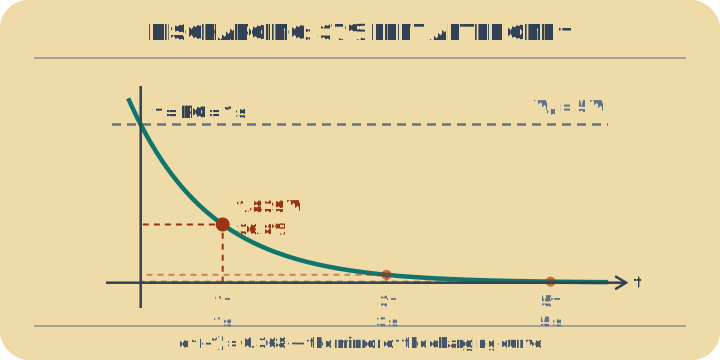
- Discharging - Discharging from 5V
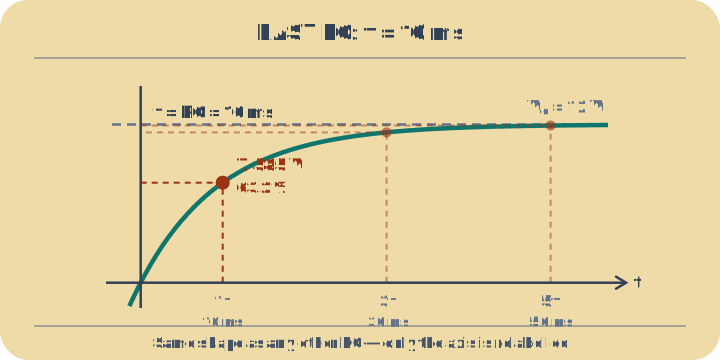
- Fast RC - Fast RC: τ=10ms
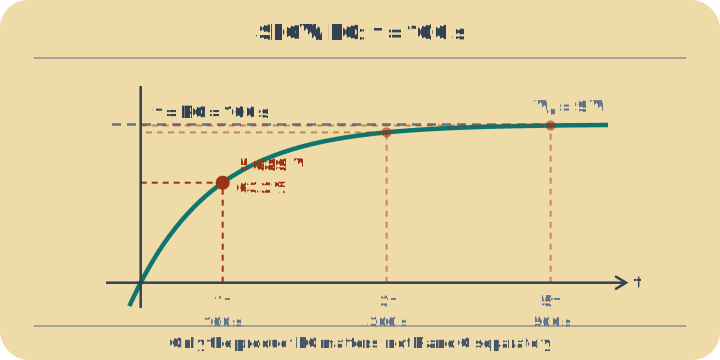
- Slow RC - Slow RC: τ=100s