A fire is measured by the oxygen it takes
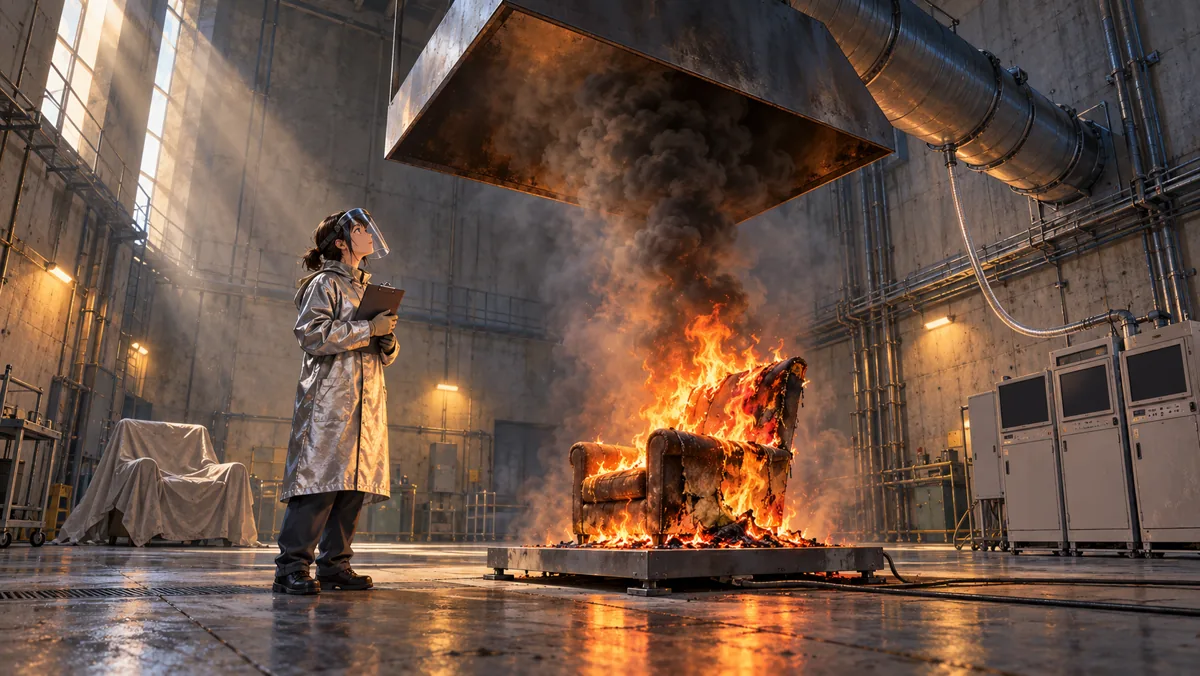
Methane gives 50.03 MJ for every kilogram burned, and sugar 14.10. Divide instead by the oxygen each one uses and they give 12.54 and 13.24. Fire laboratories depend on the second pair: they measure the heat of a burning sofa from the oxygen missing in its smoke, without ever learning what the sofa was made of.
A sofa on fire releases heat at a rate that largely decides whether the room it stands in will flash over, and nobody can tell you that rate from the sofa. The obvious method multiplies two numbers: how much heat a kilogram of the material gives, and how many kilograms burn each second. For foam, fabric, wood and glue together the first is not known, and in a full-scale test the second is hard to measure. Babrauskas and Peacock titled their 1992 review of the quantity "Heat release rate: the single most important variable in fire hazard", and the way it is measured today ignores the sofa almost entirely.
The smoke goes up into a hood and out through a duct. Instruments in the duct measure the flow and how much oxygen is missing from it, and the heat release rate is that missing oxygen multiplied by one constant: 13.1 MJ for every kilogram. The same multiplication runs in a bench-top cone calorimeter testing a ten-centimetre square of carpet and under a hood collecting the smoke of a furnished room on fire.
Per kilogram of fuel, nothing agrees
With the water leaving as vapour, the way it leaves a flame, methane releases 50.03 MJ for every kilogram burned. Octane, standing in for petrol, gives 44.42; a typical animal fat 36.48; ethanol 26.82; glucose 14.10. Those span a factor of 3.55, and nobody would guess them from one another.
Divide each by the oxygen it consumes instead. Methane gives 12.54 MJ per kilogram of oxygen, octane 12.69, the fat 12.69, ethanol 12.87, glucose 13.24. William Thornton noticed in 1917 that the heat per unit of oxygen hardly varied across a large number of organic gases and liquids. In 1980 Clayton Huggett at the US National Bureau of Standards extended the comparison to the fuels that turn up in fires and recommended 13.1 MJ per kilogram, ±5%, for all of them. Of the sixteen fuels in Heat of Combustion, eleven land inside that band.
Burning oxygen can end up in two places
The page has two rows that explain the rest. Carbon burned to carbon dioxide releases 393.51 kJ for each mole of oxygen, which is 12.30 MJ per kilogram. Hydrogen burned to water vapour makes two moles of water from each mole of oxygen and releases 483.65 kJ, or 15.12 MJ per kilogram. A fuel made of carbon, hydrogen and oxygen that burns completely has no other products, and the two are just 23% apart.
The heat is set by what the oxygen becomes, and in a clean flame it becomes carbon dioxide or water.
A hydrocarbon shares its oxygen between the two. Methane, CH₄, sends one mole of O₂ to its carbon and one to its four hydrogens, and the even blend of 12.30 and 15.12 is 13.71. The molecule itself takes a little back. Methane is about 74.5 kJ per mole more stable than the carbon and hydrogen it is made from; that energy was released when the molecule formed and cannot be released again, and it costs 1.16 MJ per kilogram of oxygen, which brings 13.71 down to the measured 12.54. Octane sends 64% of its oxygen to carbon, blends to 13.31, gives back an energy of formation worth 4.7% of that blend, and lands on 12.69.
Sugar looks as if it should break this, because it already contains oxygen. Read C₆H₁₂O₆ as six carbons and six waters and it does not. The hydrogen arrives already burned, so what is left is carbon burning, at 393.51 kJ per mole of oxygen, plus the 7.6% that glucose holds above a heap of charcoal and water vapour: 423.50 kJ, or 13.24 MJ per kilogram.
So the band is narrow for two reasons that have nothing to do with each other. Carbon and hydrogen happen to pay similar prices for oxygen, and for every hydrocarbon on the page except acetylene the molecule's own energy of formation is less than a tenth of what its carbon and hydrogen release. So is a sugar's, once its oxygen is booked as water. Neither fact needs to know what the fuel is called, which is why a furniture test does not need to know either.
A guinea pig in a bucket of ice
The idea is older than fire science. In the winter of 1782–83 Antoine Lavoisier and Pierre-Simon Laplace built a calorimeter that measured heat by the ice it melted, and they put a guinea pig inside it twice, scaled each run to ten hours, and took the mean: about 13 ounces of ice. From separate experiments on several guinea pigs they put its output of fixed air, which we call carbon dioxide, at 224 grains in the same ten hours. Burning charcoal had melted 26.692 ounces of ice for every ounce of fixed air it made, so 224 grains of it ought to correspond to 10.38 ounces. They took about 2.5 ounces off the guinea pig's 13, for its cooled extremities and the moisture its warmth had evaporated, found the two in agreement, and wrote, in a memoir read to the Académie des sciences on 18 June 1783:
La respiration est donc une combustion, à la vérité fort lente, mais d’ailleurs parfaitement semblable à celle du charbon.
Lavoisier and Laplace, Mémoire sur la chaleur, 1783
"Respiration is therefore a combustion, very slow indeed, but otherwise perfectly like that of charcoal." Their charcoal figure was excellent: modern values give 26.81 ounces of ice per ounce of carbon dioxide, 0.4% from theirs. The weak point was the yardstick. Charcoal is nearly pure carbon, and an animal burns sugar and fat, both of which release more heat for each molecule of carbon dioxide, for different reasons. Fat carries far more hydrogen than its own oxygen accounts for, and that hydrogen burns to water: in burning fat, nearly 30% of the oxygen ends up in water and makes no carbon dioxide at all. The memoir allows that breathing may change the air in other ways than turning it into fixed air and judges any such change small. Sugar has no spare hydrogen, but the molecule holds more energy than charcoal and water do. With the water condensed, as it was in the ice, glucose releases 467.50 kJ for each mole of carbon dioxide against charcoal's 393.51, and fat 619.72. Scaled from their own 10.38, the guinea pig's 224 grains predict 12.33 ounces on sugar and 16.35 on fat. The 13 ounces they weighed, before anything was subtracted, lies between the two.
Your breath is a fuel gauge
A hospital does the same calculation with oxygen instead of carbon dioxide, and on oxygen the fuels nearly agree again. With the water liquid, as it stays in you, glucose gives 20.86 kJ for every litre of oxygen and the fat 19.45. A gram of fat holds 2.51 times the energy of a gram of sugar, and a litre of oxygen gets 6.8% less out of it. A resting adult taking up a quarter of a litre a minute is a heater of 86.9 W on pure sugar and 81.0 W on pure fat, and every mixture of the two lies between.
That 6.8% is why a metabolic cart measures both gases. Burning glucose returns one molecule of carbon dioxide for every molecule of oxygen; burning the fat returns 0.70. The ratio of the two gases says which fuel is burning, and therefore where between 81.0 and 86.9 the answer sits.
Where the rule breaks
A fuel that arrives holding a lot of energy of its own escapes the band. Acetylene's formation enthalpy is +227.4 kJ per mole, energy put in when the molecule was made and returned when it burns, on top of anything the oxygen supplies. It adds 22% to what acetylene's carbon and hydrogen would give, and lifts it to 15.70 MJ per kilogram of oxygen, 19.88% above 13.1. Without it acetylene would sit at 12.86, inside the band with methane and octane.
Carbon monoxide is the stranger case, and it matters more in a fire. Burning carbon all the way to CO₂ happens in two steps, and they pay very differently. Carbon to carbon monoxide uses half a mole of oxygen and releases 110.53 kJ: 6.91 MJ per kilogram of oxygen. Carbon monoxide to carbon dioxide uses the other half and releases 282.98 kJ: 17.69. The average of the two halves is carbon's 12.30. A fire short of air stops some of its carbon at the first step, so the oxygen that went into making carbon monoxide bought barely half the heat 13.1 assumes.
The damage to the measurement is smaller than that suggests, because the oxygen that was never used is never counted either. A methane fire that leaves a fifth of its carbon as carbon monoxide releases 12.27 MJ per kilogram of the oxygen it did consume, 2.2% under the clean flame. The laboratories measure the carbon monoxide in the duct and correct for it. A smoky fire gives out less heat, and it takes in less oxygen, and the second nearly makes up for the first.
References (6)
- the 1917 observation that the heat per unit of oxygen hardly varies W. M. Thornton, "The relation of oxygen to the heat of combustion of organic compounds." The London, Edinburgh, and Dublin Philosophical Magazine and Journal of Science 33(194), 1917, pp. 196–203.
- the 13.1 MJ per kilogram of oxygen, ±5%, that fire laboratories use C. Huggett, "Estimation of rate of heat release by means of oxygen consumption measurements." Fire and Materials 4(2), 1980, pp. 61–65.
- how the missing oxygen becomes a heat release rate, and the history from Thornton to Parker J. C. Yang, "Detailed Derivations of Formulas for Heat Release Rate Calculations Revisited: A Pedagogical and Systematic Approach." Journal of Research of the National Institute of Standards and Technology 124, article 124016, 2019.
- the quantity the method measures, and the case for measuring it V. Babrauskas and R. D. Peacock, "Heat release rate: The single most important variable in fire hazard." Fire Safety Journal 18(3), 1992, pp. 255–272.
- the guinea pig in the ice calorimeter, and the sentence quoted A.-L. Lavoisier and P.-S. de Laplace, "Mémoire sur la chaleur." Read to the Académie des sciences on 18 June 1783; Mémoires de l’Académie royale des sciences, année 1780 (printed 1784). Reprinted in Œuvres complètes de Laplace, tome 10, Gauthier-Villars, pp. 149–206.
- every heat of combustion and formation enthalpy behind the figures P. J. Linstrom and W. G. Mallard (eds.), NIST Chemistry WebBook, NIST Standard Reference Database Number 69. National Institute of Standards and Technology, Gaithersburg MD.