Hohmann Transfer Calculator

minimum-energy orbit transfer - visualised

Loading interactive simulation...

why not just point and thrust? 🖖

Point your engine straight at Mars and you'll barely get there faster — most intuition fails here because velocity, not direction to the target, is what actually defines an orbit. A radial burn (straight outward) mostly fights gravity and gets circularized right back out, barely touching your orbit's energy. A prograde burn (along your direction of motion) directly raises that energy, stretching a circle into the ellipse that reaches your target — and it's most efficient exactly at periapsis, where you're already moving fastest (the Oberth effect: the same Δv buys more kinetic energy when added to a higher speed). That's why both burns in a Hohmann transfer are tangential, never radial.

the cheapest road is a curved one 🖖

A Hohmann transfer never flies straight at its destination. The spacecraft fires once to stretch its circular orbit into an ellipse that just kisses the target orbit, coasts halfway around with the engine off, then fires again to settle into the new circle. It is the most fuel-efficient two-burn route between circular orbits — you simply trade speed for savings. A hop from LEO to GEO costs about 3.9 km/s of Δv yet takes over five hours of free coasting.

sometimes the long way costs less 🖖

You would expect a bigger detour to burn more fuel, but not always. When the target orbit is more than about 11.9× larger than the start, a three-burn bi-elliptic transfer — which flings the craft far beyond the destination and back — can need less total Δv than the direct Hohmann. Swinging out to a very high turnaround point, where orbital speed is low, makes the mid-course maneuver there remarkably cheap, and that saving can outweigh the extra outbound push. The catch: the scenic route often takes many times longer.

HOHMANN TRANSFERS — WHY DISTANCE IS NOT WHAT COSTS YOU

Which Hohmann Transfer Case Are You In?

A Hohmann transfer is two burns: one to stretch your circular orbit into an ellipse that reaches the target, one to circularise at the far end. The fuel it takes is measured in Δv, and the surprise is how little that has to do with distance. What sets the price is how deep in the gravity well you start and the ratio of the two radii — so the Moon can cost barely more than a communications satellite.

The workhorse — low orbit up to geostationary Δv = 3.895 km/s, 5.3 h
Nine times further, for one percent more fuel r₂/r₁ = 57.6 → Δv = 3.938
Starting higher — the expensive part is already paid for Δv = 1.619 km/s
Around the Sun — a small ratio that still costs the most r₂/r₁ = 1.52 → Δv = 5.592

01

The workhorse — low orbit up to geostationary

What you know: Both radii around the same body. Δv₁ raises the apoapsis to the target, Δv₂ circularises there.

What to check: Δv = 3.895 km/s, 5.3 h

Worked example: From 6,671 km to 42,164 km around Earth: Δv₁ = 2.428 km/s, Δv₂ = 1.468 km/s, total 3.895 km/s, and the coast takes 5.3 hours.

Open this case: LEO → GEO
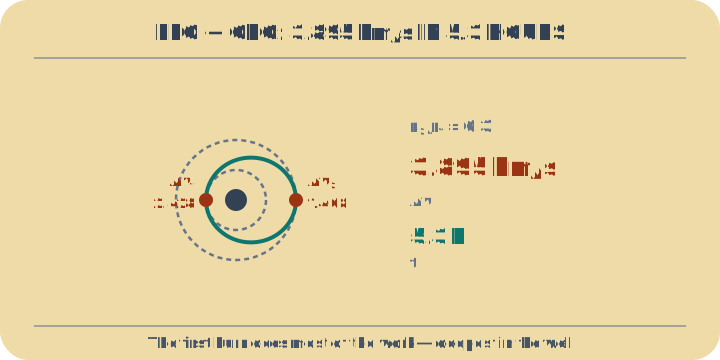
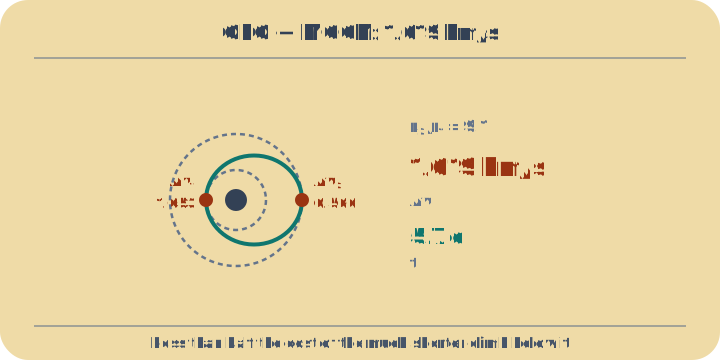
The workhorse — low orbit up to geostationary. The transfer ellipse touching the low circle at one end and the geostationary circle at the other. Both radii around the same body. Δv₁ raises the apoapsis to the target, Δv₂ circularises there.
The transfer ellipse touching the low circle at one end and the geostationary circle at the other.

02

Nine times further, for one percent more fuel

What you know: The same starting orbit, a target nine times further out. The Δv barely moves; the travel time does.

What to check: r₂/r₁ = 57.6 → Δv = 3.938

Worked example: From 6,671 km to 384,400 km: total 3.938 km/s against 3.895 for geostationary — 0.043 km/s more to go 9.1 times as far. The coast stretches from 5.3 hours to 5.0 days.

Open this case: LEO → Moon
Nine times further, for one percent more fuel. The same low circle, with an ellipse stretched out to lunar distance — a far bigger orbit for almost the same cost. The same starting orbit, a target nine times further out. The Δv barely moves; the travel time does.
The same low circle, with an ellipse stretched out to lunar distance — a far bigger orbit for almost the same cost.

03

Starting higher — the expensive part is already paid for

What you know: The same lunar target, but departing from geostationary instead of low orbit.

What to check: Δv = 1.619 km/s

Worked example: From 42,164 km to 384,400 km: total 1.619 km/s — less than half the 3.895 km/s it took just to reach geostationary in the first place.

Open this case: GEO → Moon
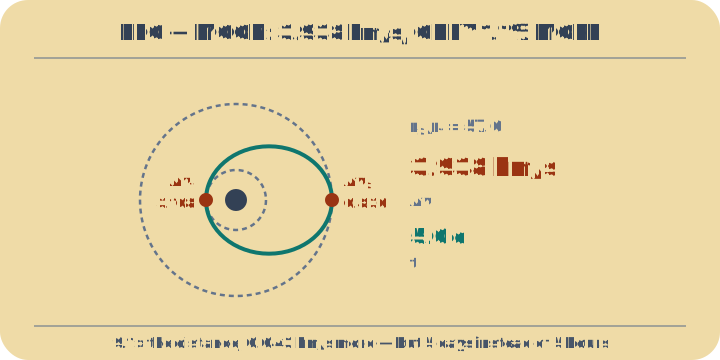
Starting higher — the expensive part is already paid for. A transfer between two already-high orbits, where the curve of the ellipse is gentle and the burns are small. The same lunar target, but departing from geostationary instead of low orbit.
A transfer between two already-high orbits, where the curve of the ellipse is gentle and the burns are small.

04

Around the Sun — a small ratio that still costs the most

What you know: The same two-burn geometry with the Sun as the central body. Radii differ by only half, yet this is the priciest case here.

What to check: r₂/r₁ = 1.52 → Δv = 5.592

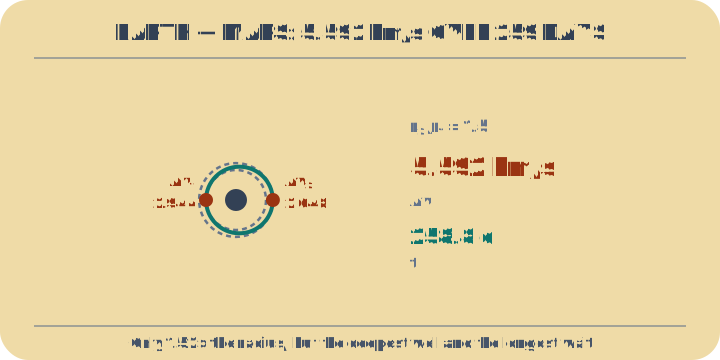
Worked example: From 149.6 million km to 227.9 million km: Δv₁ = 2.944 km/s, Δv₂ = 2.648 km/s, total 5.592 km/s, and the transfer takes 258.8 days.

Open this case: Earth → Mars
Around the Sun — a small ratio that still costs the most. The transfer ellipse between two nearly equal solar orbits, with the burns close to the same size. The same two-burn geometry with the Sun as the central body. Radii differ by only half, yet this is the priciest case here.
The transfer ellipse between two nearly equal solar orbits, with the burns close to the same size.
References (2)

Problems solved in full

  1. Moving a 1-tonne satellite from a 300 km parking orbit to geostationary altitude 5 steps

    A 1-tonne satellite has to be moved from a 300 km parking orbit to geostationary altitude. Find both burns, and then find what fraction of the vehicle leaving the parking orbit has to be propellant. Take r₁ = 6671 km, r₂ = 42164 km, and Earth’s gravitational parameter μ = 398600 km³/s².

    1. A Hohmann transfer is half of an ellipse that just touches both circles — perigee on the inner one, apogee on the outer. That fixes its semi-major axis before any speed is calculated, because the major axis simply spans from one orbit to the other.

    2. Everything else comes from one equation, vis-viva, which gives the speed at any radius on any orbit: v² = μ(2/r − 1/a). On a circle a = r, and it collapses to the familiar circular speed. That is how fast the satellite is already going.

    3. Now apply the same equation at the same radius but on the transfer ellipse, where a = at. The satellite is at the lowest point of a much larger orbit, so it needs to be moving faster. The first burn buys exactly that difference — the engine changes the orbit, not the position.

    4. Coast to apogee and the ellipse has slowed right down: angular momentum is conserved, so climbing costs speed. But a circular orbit at that height needs more than the ellipse has left, which is why the second burn is a speed-up too, not a brake. Without it the satellite falls straight back to perigee.

    5. A rocket cannot spend Δv directly; it spends mass, at an exchange rate set by the exhaust velocity. For a storable upper stage with a specific impulse of 320 s, ve = 320 × 9.80665 = 3.138 km/s, and Tsiolkovsky converts the total.

    Answer

    The two burns are 2.428 km/s and 1.468 km/s — and those are exactly the figures the calculator above prints for the same two radii, which is the point: the tool is not an oracle, it is doing these five lines. The sting is in the last one. 71% of everything leaving the parking orbit is propellant, so a 1-tonne satellite needs 3.46 tonnes departing LEO. Δv adds, but mass compounds — that exponential is why a modest-looking 3.9 km/s dominates the design of the whole upper stage.

  2. The crossing and launch date for a Mars mission 5 steps

    You are scheduling a Mars mission. Work out how long the crossing takes, and then the thing that actually decides the launch date: where Mars has to be when you leave, and how often that happens. Take Earth’s orbit as 1.000 AU, Mars’ as 1.523 AU, and Mars’ year as 687 days.

    1. Same construction as before, one scale up: the transfer ellipse touches Earth’s orbit at perihelion and Mars’ at aphelion, so its semi-major axis is the mean of the two.

    2. Kepler’s third law then gives the period outright — in astronomical units and years the constants vanish and it is just T = a3/2. You only fly half the ellipse, so halve it. Check that against the calculator above: it reports 258.8 days for this transfer, from the same geometry.

    3. Here is what the transfer time is really for. Mars does not wait at the arrival point — it has to be delivered there too, by its own orbit, in exactly the time you spend crossing. So work out how far round Mars gets while you are in flight.

    4. You arrive 180° round from where you left. Mars covers 135.6° in the same interval, so at the instant of departure it must still be short of the arrival point by the difference. Aim at where Mars is and you arrive months behind it.

    5. That alignment is not a date, it is a beat frequency: the two planets return to the same relative geometry at the synodic period, which is the difference of their angular rates.

    Answer

    You may leave only when Mars leads Earth by 44.4°, and that recurs every 780 days — about 26 months. This is why Mars launches arrive in clusters, why a slip of three weeks in testing can cost two years, and why every mission profile is quoted against a named window. None of it is visible in the 258.8-day crossing time on its own; it only appears once you compare that number with how far the target moves meanwhile.

Learning path

Orbits from two numbers

Leads to The rocket equation the cheapest route between two circular orbits, as two burns on a half-ellipse that touches both.

Example problems

  • LEO → GEO - LEO→GEO: r1=6671 km, r2=42164 km → Δv≈3.9 km/s total, ~5.3 h transfer
  • LEO → Moon - LEO→Moon distance: r1=6671 km, r2=384400 km → Δv≈3.9 km/s, ~5 days
  • GEO → Moon - GEO→Moon distance: r1=42164 km, r2=384400 km → Δv≈1.1 km/s, ~5.7 days
  • Earth → Mars - Earth→Mars: r1=149.6M km, r2=227.9M km → Δv1≈2.95 km/s, ~259 days
  • Mars → Earth - Mars - Earth