Hohmann Transfer Calculator
minimum-energy orbit transfer - visualised
why not just point and thrust? 🖖
Point your engine straight at Mars and you'll barely get there faster — most intuition fails here because velocity, not direction to the target, is what actually defines an orbit. A radial burn (straight outward) mostly fights gravity and gets circularized right back out, barely touching your orbit's energy. A prograde burn (along your direction of motion) directly raises that energy, stretching a circle into the ellipse that reaches your target — and it's most efficient exactly at periapsis, where you're already moving fastest (the Oberth effect: the same Δv buys more kinetic energy when added to a higher speed). That's why both burns in a Hohmann transfer are tangential, never radial.
the cheapest road is a curved one 🖖
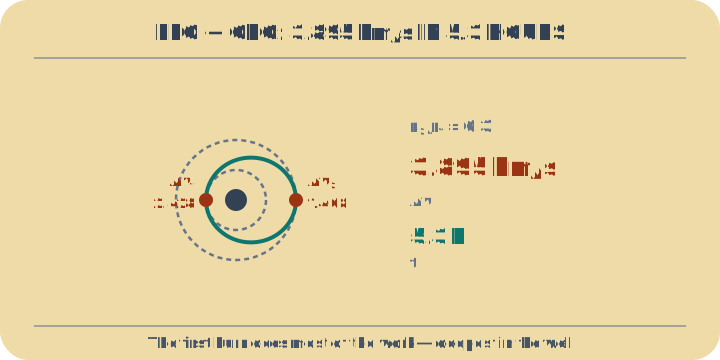
A Hohmann transfer never flies straight at its destination. The spacecraft fires once to stretch its circular orbit into an ellipse that just kisses the target orbit, coasts halfway around with the engine off, then fires again to settle into the new circle. It is the most fuel-efficient two-burn route between circular orbits — you simply trade speed for savings. A hop from LEO to GEO costs about 3.9 km/s of Δv yet takes over five hours of free coasting.
sometimes the long way costs less 🖖
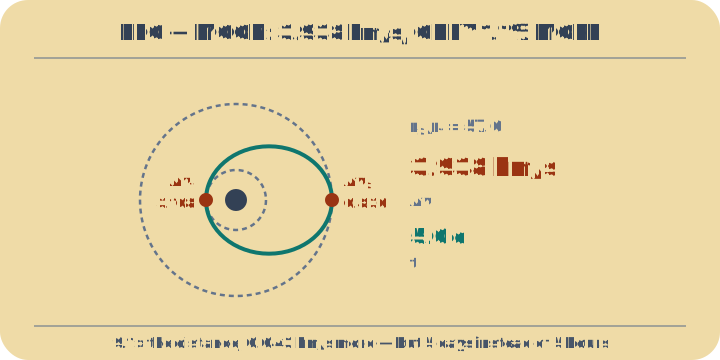
You would expect a bigger detour to burn more fuel, but not always. When the target orbit is more than about 11.9× larger than the start, a three-burn bi-elliptic transfer — which flings the craft far beyond the destination and back — can need less total Δv than the direct Hohmann. Swinging out to a very high turnaround point, where orbital speed is low, makes the mid-course maneuver there remarkably cheap, and that saving can outweigh the extra outbound push. The catch: the scenic route often takes many times longer.
Example problems
- LEO - GEO - LEO→GEO: r1=6671 km, r2=42164 km → Δv˜3.9 km/s total, ~5.3 h transfer
- LEO - Moon - LEO→Moon distance: r1=6671 km, r2=384400 km → Δv˜3.9 km/s, ~5 days
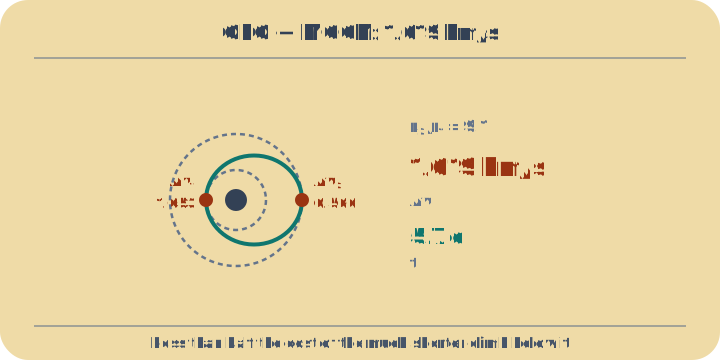
- GEO - Moon - GEO→Moon distance: r1=42164 km, r2=384400 km → Δv˜1.1 km/s, ~5.7 days
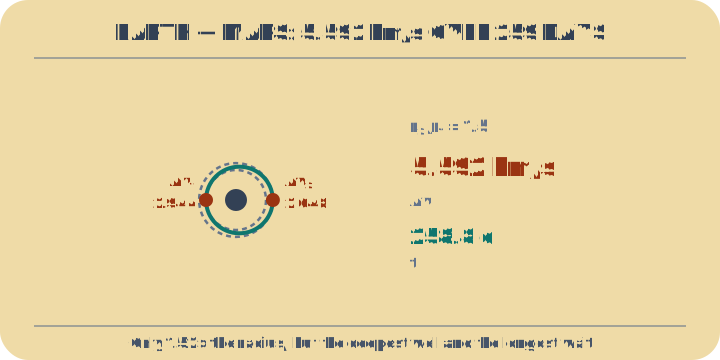
- Earth - Mars - Earth→Mars: r1=149.6M km, r2=227.9M km → Δv1˜2.95 km/s, ~259 days
- Mars - Earth - Mars - Earth