Radiometric Dating Calculator

Geology-focused isotope dating with timescale suitability guidance.

Loading interactive simulation...

The statistics of radioactive decay 🖖

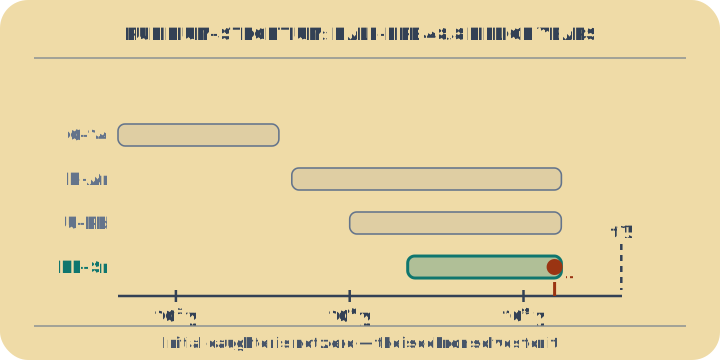
Radiometric dating relies on the steady, statistical law of radioactive decay: N(t) = N_0 e^(-λt). In any sample containing billions of unstable parent atoms, the probability of decay per unit time is a constant, unaffected by temperature, pressure, or chemical bonds. This yields a clock of remarkable accuracy. By measuring the ratio of remaining parent isotopes to accumulated daughter isotopes, geologists can calculate the time elapsed since the rock cooled and locked its crystal structure. However, this clock requires a closed system. If parent or daughter isotopes escape due to weathering or metamorphism, the clock is reset or distorted. Modern geochronologists use multiple decay systems (like U-Pb and K-Ar) in parallel to cross-verify ages and detect open-system behavior.
Half-life: nature's built-in stopwatch 🖖

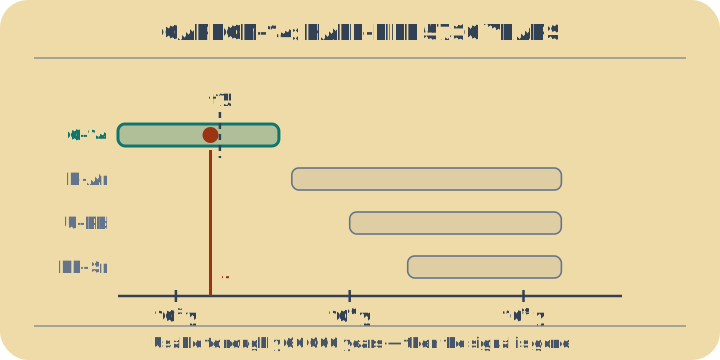
The key idea is the half-life: the fixed time it takes for half of a radioactive parent isotope to decay into its daughter. After one half-life 50% of the parent remains; after two, 25%; after three, 12.5%. Because the fraction halves each interval, the amount of parent left tells you how many half-lives have passed. Enter a parent fraction of 0.25 and the tool reports an age of two half-lives — for carbon-14 (half-life ≈ 5,730 years) about 11,460 years.

The bomb pulse dates the living 🖖

Atmospheric nuclear weapons tests between 1955 and 1963 nearly doubled the amount of carbon-14 in the air, creating a sharp bomb pulse. After the 1963 test-ban treaty this excess radiocarbon fell off steadily as it mixed into oceans and plants. Forensic scientists now read that decline in tooth enamel or eye-lens tissue to pin a person's year of birth to within a year or two — and to unmask forged wines and paintings made after 1950.

Example problems

  • wood artifact - Carbon-14 dating for organic remains in archaeological timescales.
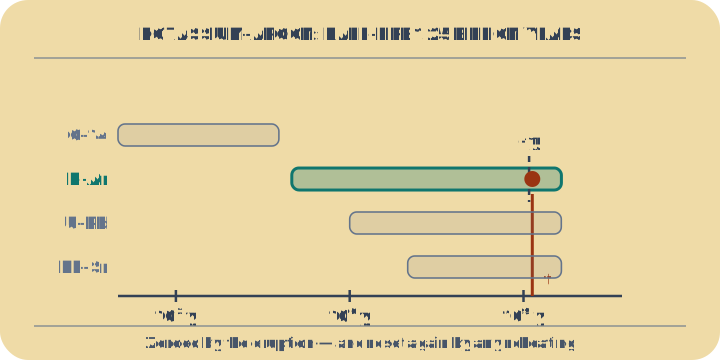
  • basalt flow - K-Ar style volcanic rock age estimate in million-year range.
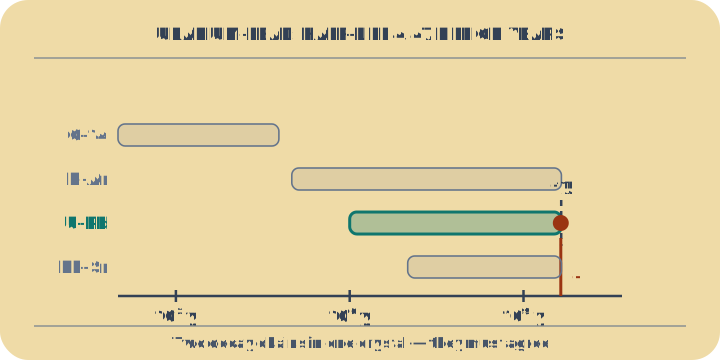
  • zircon crystal - U-Pb zircon dating for deep geological time.