Hooke's Law & Spring Lab

Explore force, spring constant, displacement, stored elastic energy, and series/parallel springs in real time.

Loading interactive simulation...

Potential wells and harmonic motion 🖖

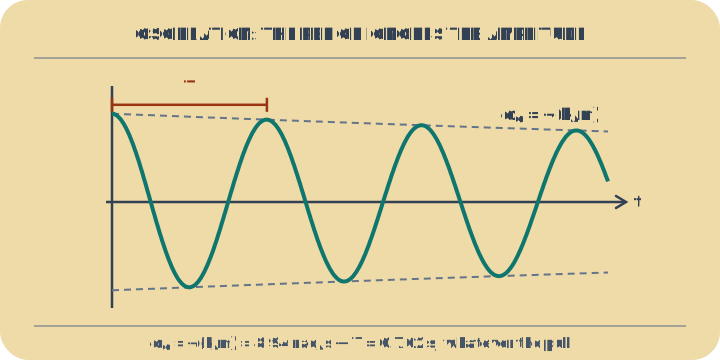
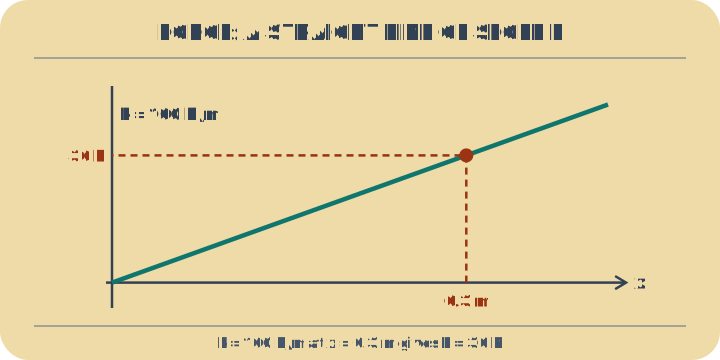
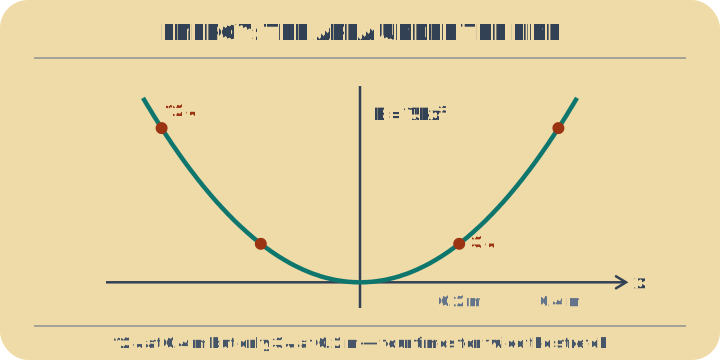
Hooke's law, F = -kx, describes the linear elastic behavior of materials under deformation. The negative sign represents the restoring force, pushing the system back toward its equilibrium state. At the atomic scale, Hooke's law is a first-order approximation of the Lennard-Jones potential, which governs chemical bonds between atoms. Near the bottom of any stable potential well, the potential energy curve is approximately quadratic, U = 1/2 kx². This quadratic energy state means that any small disturbance will result in simple harmonic motion, where the frequency of oscillation is independent of the amplitude. Hooke's law is thus the mathematical gateway to understanding sound waves, mechanical vibrations, crystal lattices, and quantum harmonic oscillators.
Stiffness, and how springs team up 🖖

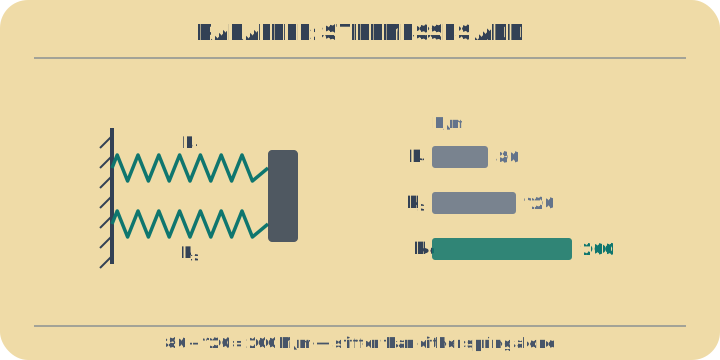
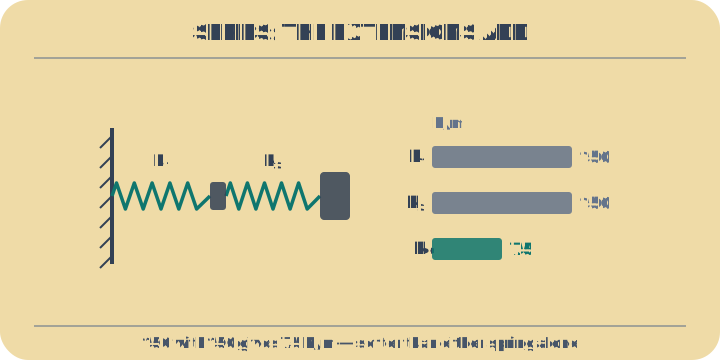
Hooke's law just says a spring pushes back in direct proportion to how far you stretch or squeeze it — the spring constant k is simply its stiffness, in newtons per metre. The systems mode reveals a tidy surprise: two identical springs side by side (parallel) double the stiffness, but those same two joined end to end (series) become only half as stiff. Chaining springs makes them softer, not stronger.

Hooke hid his law inside an anagram 🖖

In 1676 Robert Hooke was not ready to reveal his discovery, so he published it as a scrambled Latin anagram: ceiiinosssttuv. Two years later he unscrambled it — ut tensio, sic vis, "as the extension, so the force." He was guarding his priority while racing to build spring-driven watches. That same linear law now sits inside kitchen scales, car suspensions, and the click of a retractable pen.

Example problems