SHM Resonance Lab

Tune mass, spring, damping, and forcing frequency to see resonance, phase lag, and amplitude magnification in real time.

Loading interactive simulation...

Second-Order ODE Resonances 🖖

Damped harmonic oscillators are described by a characteristic equation...

Resonance is just good timing 🖖

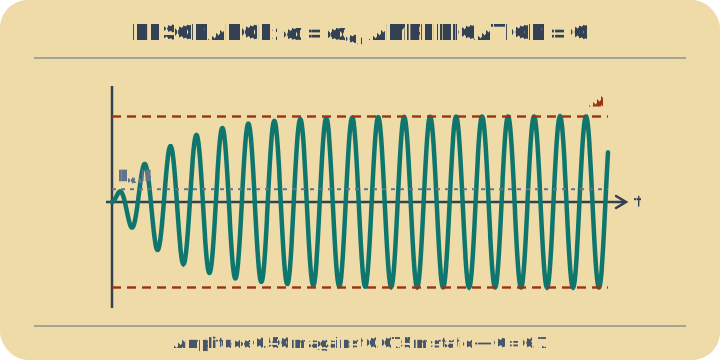
This tool is really about timing. Every mass on a spring has one natural frequency Ο‰β‚€ at which it 'wants' to wobble. Push it at that rhythm β€” like pumping a playground swing at just the right moment β€” and each small shove adds energy, so the amplitude X grows far beyond what a steady force would give. The magnification M measures that boost, and only damping keeps it from running away. At resonance the motion lags the force by exactly 90Β°.

The peak sits below the natural frequency 🖖

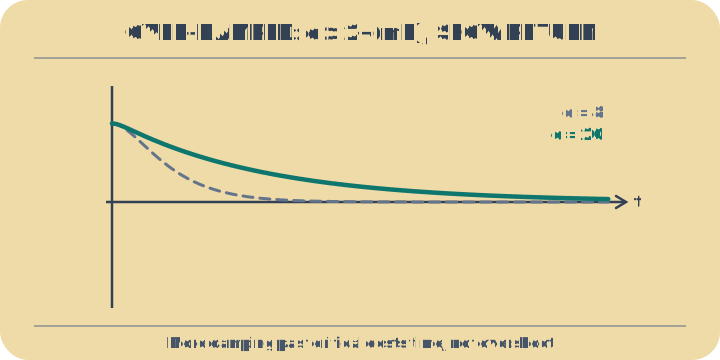
Draw the resonance curve and you might expect its tallest point at Ο‰ = Ο‰β‚€. It isn't: the displacement amplitude actually peaks slightly lower, at Ο‰_r = Ο‰β‚€βˆš(1 βˆ’ 2ΞΆΒ²). Stranger still, once the damping ratio passes ΞΆ = 1/√2 β‰ˆ 0.707 β€” well before critical damping at ΞΆ = 1 β€” that peak vanishes entirely and the curve just slides downhill. So a system can be lightly damped and yet have no resonant peak at all.

Example problems

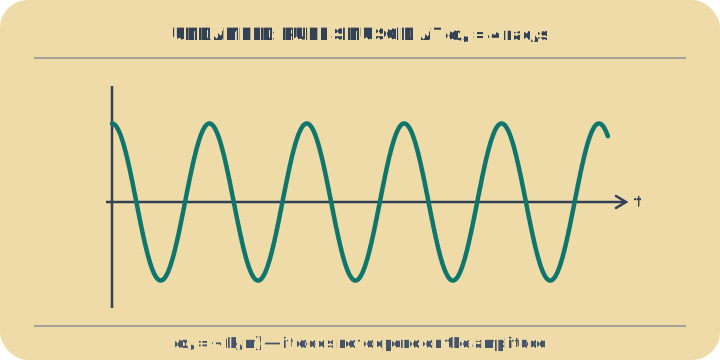
  • Undamped free - Undamped free oscillation: pure sinusoidal energy exchange
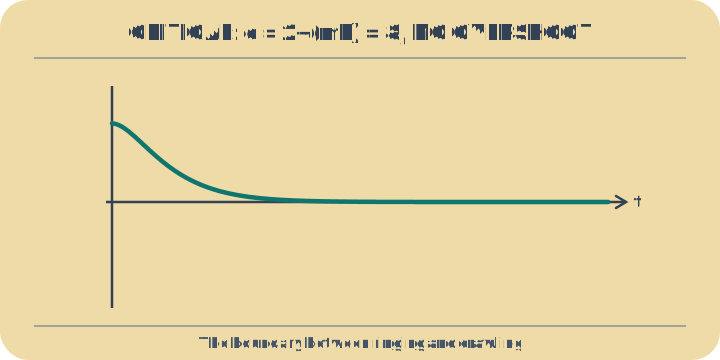
  • Critical damping - Critical damping: fastest return to equilibrium without overshoot
  • Near resonance - Near resonance: forcing frequency near natural frequency gives high amplitude
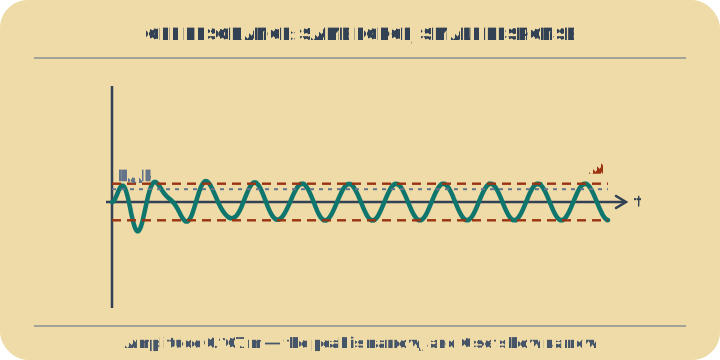
  • Off resonance - Off resonance: same forcing, much smaller steady-state response