Simple Pendulum / SHM

period, energy, and isochronism - animated

Loading interactive simulation...

why mass doesn't matter — Galileo was right 🖖

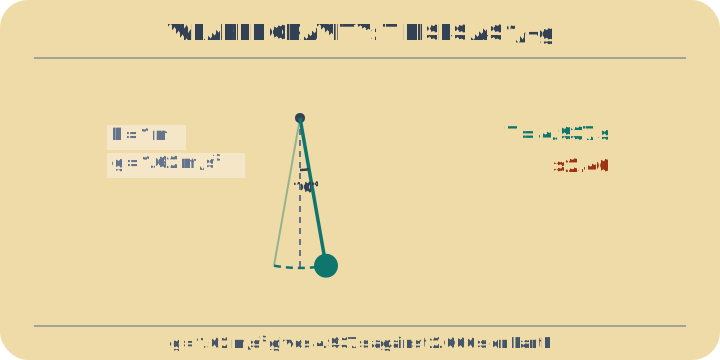
Drop a 10 kg bowling ball and a 1 g feather from the same height (no air resistance) — they land at the same instant. A pendulum works the same way: gravity pulls harder on a heavier bob, but the bob also has more inertia to overcome. The two effects cancel exactly, so mass drops out of the equation entirely. Only length and gravity remain. The two pendulums below share the same length but different gravity — Earth swings fast, the Moon swings slow.

isochronism — why swings keep time 🖖

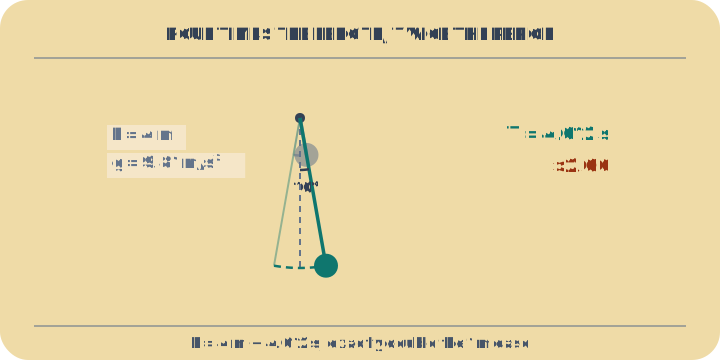
Give a pendulum a tiny nudge or a big push and — for modest swings — each round trip takes almost exactly the same time. This amplitude-independence is called isochronism, and it's why a pendulum keeps steady time even as its swing slowly dies down. The period follows T = 2π√(L/g), so length rules through a square root: to make the tick twice as slow you need four times the length, not two.

a clock that weighed the Earth's shape 🖖

In 1672 the astronomer Jean Richer carried a precise pendulum clock from Paris to Cayenne, near the equator — and it lost about 2.5 minutes a day. The pendulum hadn't changed; gravity had. Earth spins, so it bulges at the equator where g is weaker, stretching every period slightly. Newton seized on this: a humble clock had measured the planet's shape, proving Earth is an oblate spheroid, not a perfect sphere.

Example problems

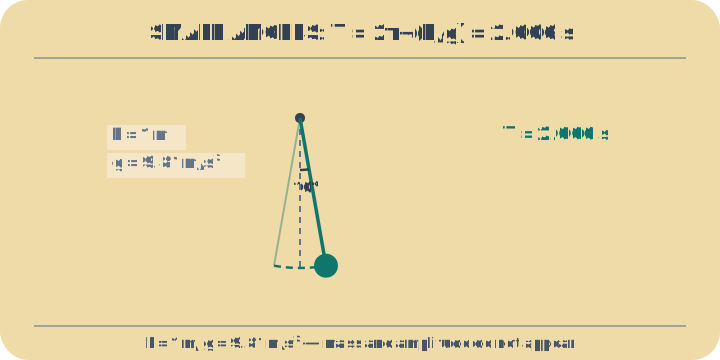
  • 1m, Earth - L=1m, Earth — T=2.006 s, classic grandfather-clock length
  • 1m, Moon - L=1m, Moon (g=1.62) — T=4.939 s, 2.5× slower than on Earth
  • 4m, Earth - L=4m, Earth — T=4.013 s; quadruple length doubles the period
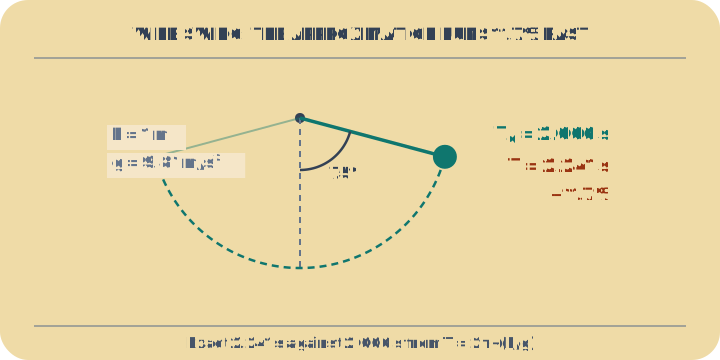
  • large angle - θ₀=75°, L=1m — T˜2.17 s; exact period is ~8% longer than small-angle approx