Derivative & Tangent Explorer
drag a point along a curve to see the slope
Infinitesimal Differential Operators 🖖
The derivative is the mathematical cornerstone for analyzing dynamic systems. By evaluating the limit of the difference quotient as it approaches zero, we explicitly calculate the exact instantaneous rate of change. This local linear approximation is foundational to manifold calculus.
Zoom in and the curve looks straight 🖖
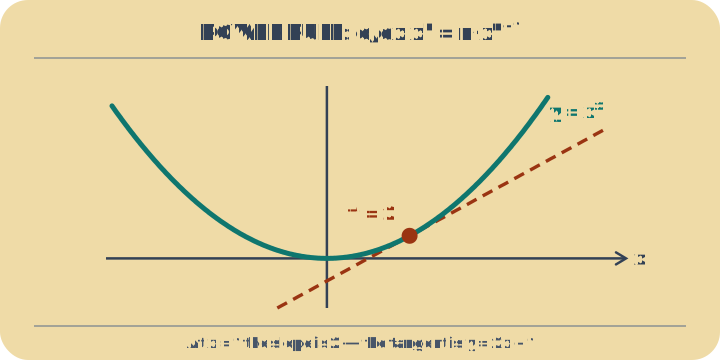
Pick any smooth curve, zoom in close enough, and the bend disappears — locally it looks like a straight line. The derivative is simply the steepness of that line, and dragging the point here reads it off directly. A car's speedometer works the same way: it shows how fast your position is changing right now, not your average speed for the whole trip. Drag the point to the top of the parabola and the slope hits 0 — that flat spot marks a peak or a valley.
The curve with no tangent anywhere 🖖
Every function here has a clean tangent, but not every function does. In 1872 Karl Weierstrass built a function that is continuous everywhere yet has a defined slope nowhere — infinitely jagged at every scale, so no tangent line can ever settle. It stunned mathematicians who assumed a smooth-looking continuous curve must have tangents almost everywhere. The same nowhere-differentiable roughness later turned up in nature: the paths of Brownian motion and the outlines of coastlines behave exactly this way.
Example problems
- x² at x=1 - f(x)=x² at x=1 → slope f'(1)=2, tangent y=2x-1
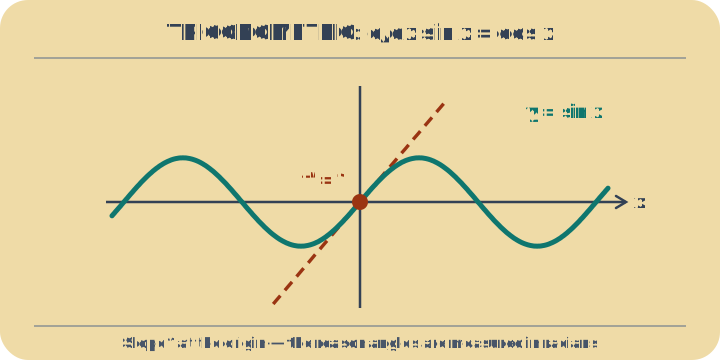
- sin at x=0 - f(x)=sin x at x=0 → slope f'(0)=1, tangent y=x
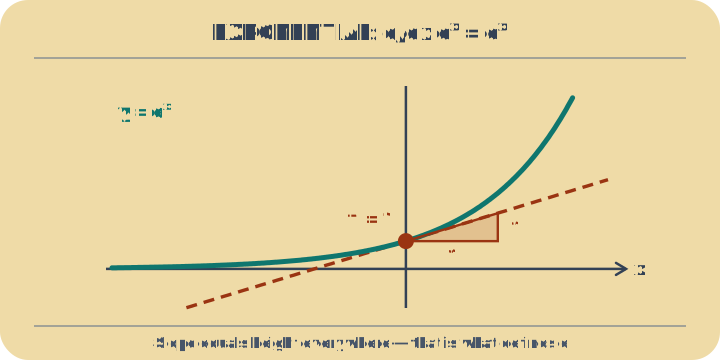
- e^x at x=0 - f(x)=eˣ at x=0 → slope f'(0)=1; eˣ is its own derivative
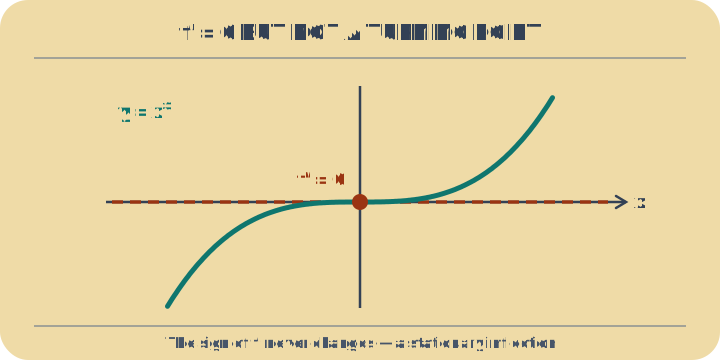
- x³ inflection - f(x)=x³ at x=0 → slope f'(0)=0, inflection point (not a min or max)