The night sky should be as bright as the Sun. Step outside and check.
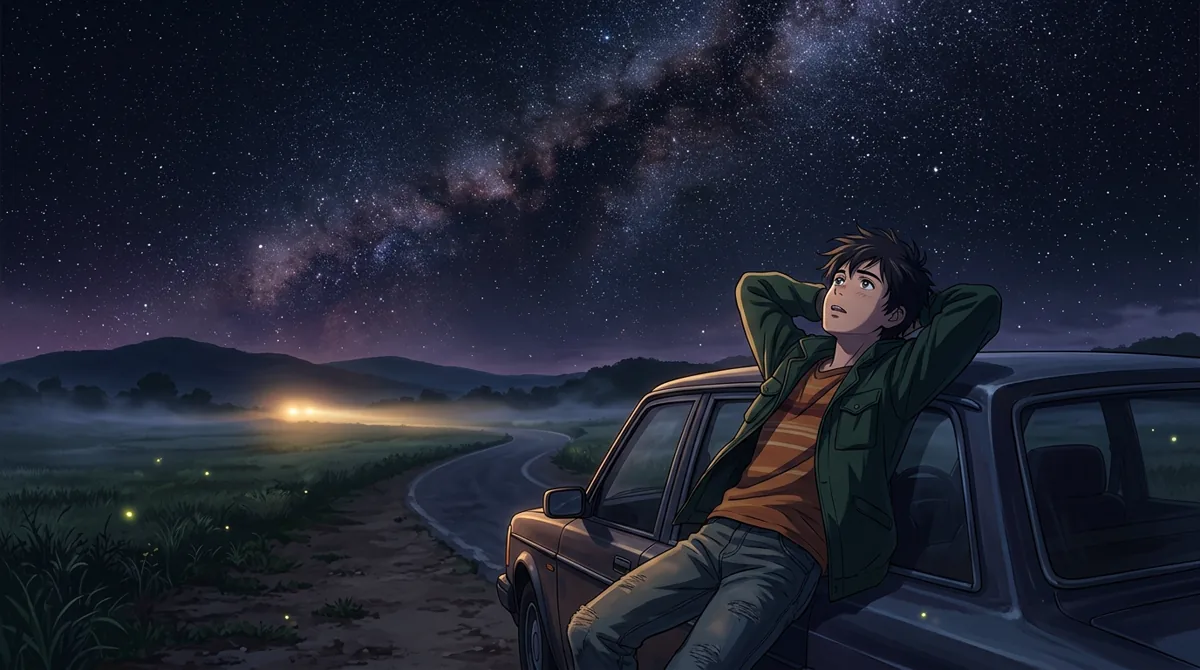
Point in any direction and keep going. In an eternal universe you hit a star. The fact that you do not is the strongest naked-eye evidence that time had a start.
Here is an argument with no equipment in it.
Suppose the universe goes on forever and has always existed, with stars scattered through it at roughly even density. Pick a direction and follow that line of sight outwards. Sooner or later it lands on the surface of a star: it has infinitely far to travel and infinitely many chances.
Now do that for every direction. Every line of sight ends on a stellar surface, so the entire sky should be as bright as the surface of a star. Not a scattering of dots on black: a continuous glare, day and night, in every direction.
Go outside. It is dark. Something in the setup is wrong.
The arithmetic that makes it worse
The tempting escape is distance — surely far-off stars are too faint to matter?
They are individually, and it does not help. Brightness falls as 1/r², so a star twice as far away delivers a quarter of the light. But consider a shell of space at distance r and thickness dr: its volume, and therefore the number of stars in it, grows as r². The two factors cancel exactly. Every shell contributes the same total brightness, and an infinite universe has infinitely many shells.
That cancellation is the paradox's engine, and it is why the answer cannot be "the far ones are dim". Dimness and abundance are in perfect balance. Nearer stars blocking further ones is the only geometric relief, and that is precisely what produces the uniform glare rather than avoiding it. The sky fills in.
The resolution is the age of the universe
The setup has two assumptions and only one of them needs to fail.
The universe is about 13.8 billion years old. Light travels at a finite speed. So we can only see out to roughly 13.8 billion light years, not because there is a wall there, but because light from anything further has not had time to arrive. The light travel time tool is a way of feeling this directly: every distance you put in is also a date, and beyond a certain distance the date is before there was anything to see.
The line of sight, in other words, does not go on forever. It stops after a finite number of shells, and a finite number of shells is a finite brightness. A dark sky.
Notice what this means. The darkness overhead is not an absence of information. It is a measurement. Its message is that the universe has not been making starlight for an unlimited time. You are reading, with the naked eye, a fact about the beginning of everything.
Redshift helps, but it is not the answer
Expansion is the resolution most people reach for, and it is a real effect that is nevertheless secondary.
Light from distant sources arrives stretched, which reduces its energy: the redshift tool shows the scale factor a = 1/(1+z), so light emitted when the universe was a quarter of its present size arrives with a quarter the energy per photon and at a lower rate. That does dim the far sky.
But Wesson's 1991 accounting is clear about the ranking: the finite age does the overwhelming share of the work, and redshift trims what is left. Switch off expansion in a 13.8-billion-year-old universe and the sky is still dark. Switch off the finite age in an expanding one and it is not. The paradox is solved by the clock, not the stretching.
There is a nice consistency check available. The sky is not perfectly dark: it glows faintly at microwave wavelengths, in every direction, at 2.725 K. That is the cosmic microwave background, and it is exactly what Olbers was looking for: a uniform sky-filling radiation from a surface at every line of sight. It exists, it is uniform, and it has been redshifted from the visible into the microwave by a factor of about 1,100. The blazing sky is there. It has simply cooled out of sight, which is a statement about time again.
From the scale tool's point of view, the argument needs no telescope, no photometry and no cosmology. Kepler worried about it in 1610, long before anyone knew what a galaxy was. The conclusion — that the universe cannot be both infinitely old and full of stars — was available for three centuries before the evidence that confirmed it, to anyone who took the darkness seriously enough to ask why.
References (1)
- the modern accounting: finite age dominates, redshift is secondary Wesson (1991). Olbers’s paradox and the spectral intensity of the extragalactic background light. The Astrophysical Journal 367.