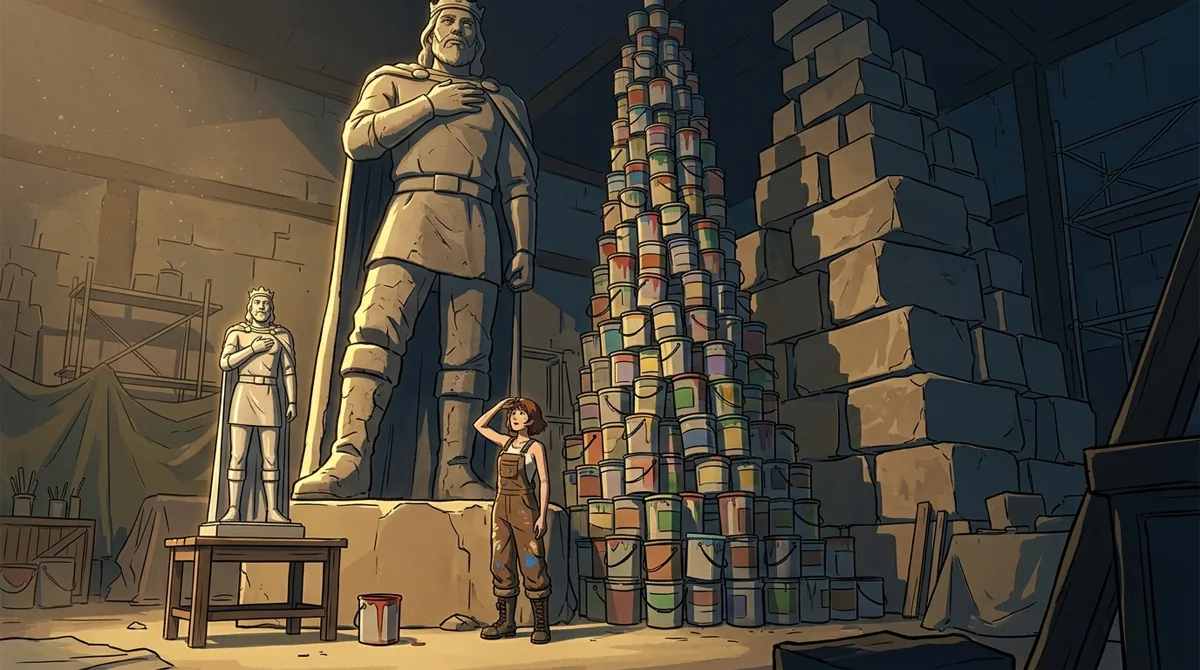
Twice as tall is four times the paint, and eight times the concrete
A 16-inch pizza has 78% more pizza than a 12-inch one. Almost nobody says 78%, and the gap between what people say and 78% is where a great deal of money lives.
A pizza of twice the diameter is four pizzas. Not two.
This is the single most reliable way to catch out an otherwise numerate adult, and the error is not one of calculation. Nobody who is asked "what is 2 squared" gets it wrong. The error happens earlier, in the step where a mental image of "twice as big" is formed and quietly assigned the number 2.
The rule
Scale a shape by a factor k — every length multiplied by k, every angle left alone — and three things happen at three different rates.
- Every length is multiplied by k. Sides, perimeters, diagonals, circumferences.
- Every area is multiplied by k². Surfaces, cross-sections, footprints, the amount of paint.
- Every volume is multiplied by k³. Contents, mass at fixed density, the amount of concrete.
- Every angle is unchanged. That is what "same shape" means.
Euclid states the area half of this for triangles in Elements VI.19 — "similar triangles are to one another in the duplicate ratio of the corresponding sides", where "duplicate ratio" is his phrase for the square of the ratio — and extends it to similar polygons generally in VI.20.
The k² can be made countable rather than asserted. Scale a triangle by a whole number and the big one can be cut into exactly k² copies of the small one: four at double, nine at triple, sixteen at quadruple. The Similar Triangles Lab draws that subdivision, so the factor is something you count rather than something you are told.
Where it costs money
Paint and materials. A model at 1:2 needs a quarter of the surface coating, not half. Quote a repaint on a building twice the height of the last one and you need four times the paint, assuming the shape is the same.
Pizza and coffee. A 16-inch pizza has 1.78 times the area of a 12-inch one, so it is worth 78% more, not 33% more. Pricing that assumes linearity is systematically wrong, in the seller's favour, in almost every takeaway in the world.
Images. Double the width of a photograph and you need four times the pixels, four times the storage and roughly four times the processing. This is why an innocuous "let us support retina displays" ticket is not a small ticket.
Heating and cooling. Heat is lost through surface (k²) and stored in volume (k³), so the surface-to-volume ratio falls as 1/k. A large building loses proportionally less heat than a small one of the same shape; a small animal loses proportionally more; a crushed ice cube melts faster than an intact one of the same total mass because crushing multiplies surface without touching volume.
Where it stops things existing
The k² versus k³ split is not merely an accounting matter. It sets hard limits on what can be built and what can live.
The strength of a leg, a bone or a column is governed by its cross-sectional area — k². The weight it must carry is governed by volume — k³. Scale an animal up by a factor of ten with its proportions unchanged and it becomes a thousand times heavier while its bones become only a hundred times stronger. The stress in the bone goes up tenfold.
This is why an elephant is not a scaled-up gazelle. Its legs are proportionally far thicker, held straighter beneath it, and it cannot jump. It is why the giant insects of films are impossible: an ant enlarged to the size of a horse would be crushed by its own weight long before its tracheal breathing failed. Galileo worked this out in 1638, in the Two New Sciences, and drew a picture of the absurdly thickened bone a large animal would require.
It is why very large ships are structurally different objects from small ones rather than bigger versions of them, and why the scaling of a bridge design is never a matter of multiplying the drawings.
Why the mistake is so durable
Because "twice as big" is a phrase about perception, and perception is not calibrated in any of the three units.
Shown two circles where one has four times the area of the other, most people will not say "four times". They will say something closer to two and a half. Perceived magnitude does not track physical magnitude linearly: it follows a power law, and for area the exponent measured in the psychophysics literature is well below one, roughly 0.7 to 0.9, depending on the task. The consequence is that the error has a consistent direction. People systematically underestimate how much larger the larger thing is, which is why bubble charts mislead, and why they mislead far worse when the software sizes the bubbles by diameter instead of by area, which stacks a second squaring on top of a perceptual bias already pointing the same way.
Arithmetic does not repair a perceptual bias. A picture might. The reason to draw the four copies inside the doubled triangle, rather than write ×4 next to it, is that the reader is not failing to multiply — they are failing to see.
A rule of thumb
When someone says something is "twice the size", ask which of the three they mean. Twice the length, four times the area, and eight times the volume are all "twice as big" in ordinary speech, and they differ by a factor of four between the extremes.